

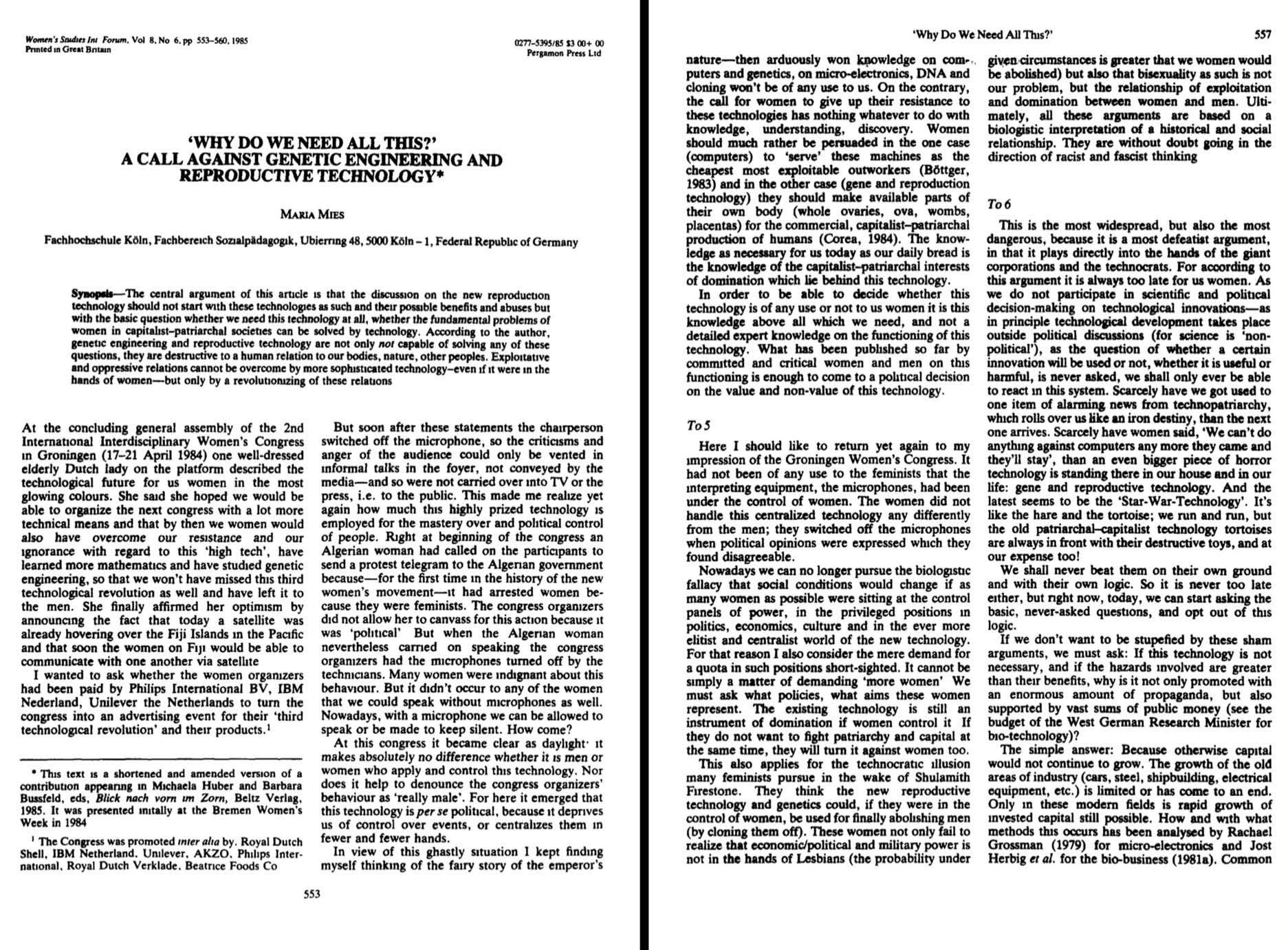
I have been reading feminist criticism of Shulamith Firestone’s Dialectic of Sex, first published in October 1970, and came across this interesting 1985 article from Maria Mies: “‘Why Do We Need All This?’ A Call Against Genetic Engineering and Reproductive Technology.”1
There are some issues with the criticisms of Firestone, including from Mies. While Firestone expressed idealism about technology for women and children, being twenty-five years old, she nevertheless had written, at the beginning of Dialectic, how “the new technology, especially fertility control, may be used against them to reinforce the entrenched system of exploitation.”2 Firestone’s Dialectic was grandiose in scope, like very much utopian/dystopian literature. The primary areas that critics address happen to be (1) her view that “Pregnancy is barbaric,” a function of women’s enslavement to female biology, and (2) her solution being “artificial reproduction” and technological advancement toward the elimination of “the sex distinction.” But her critics have emphasized her idealism about technology, without mentioning her warning about “the new technology.” At twenty-five, she had the insight to see the dystopian lurking within the utopian—and this point goes mostly unmentioned in criticism of Dialectic.
As to Mies’s 1985 article, I think she was correct about the problems of genetic engineering and reproductive technology, and time has proven it, but I also wish criticism of Firestone were more balanced—not only there but elsewhere. She was a young woman when she wrote Dialectic, as twenty-five is quite young for a book, and, some years later, was diagnosed with schizophrenia.3 Her second and only other work was Airless Spaces, published in 1998, a collection of written portraits, based on her experiences in psychiatric facilities. Of the major radical feminist works published in 1970, that golden year, I think Dialectic took some of the harshest criticism and has continued to be what Ann Snitow called “[t]he most famous demon text.”4 It was not surprising that her mental health deteriorated so awfully—and she virtually disappeared into those “airless spaces.”
Dialectic certainly has its flaws, and Firestone had an idealism about technology, to the extent that Mies’s use of “technocratic illusion” mostly fairly characterizes her vision, but I also think many readings have been misreadings, if not misrepresentations. Arguments like Midge Decter’s “Nine Lives of Population Control,” published in 1993, have since used women like Margaret Sanger, Simone de Beauvoir, and Firestone to claim that feminists have been uncritical about technology. In Decter’s view, radical feminists like Firestone, as Sanger’s “granddaughters” and Beauvoir’s “daughters,” essentially carried forth “eugenics,” which for her includes all forms of birth control, without formulating any criticism of how “the new technology” may be used against women and children. Others have repeated variations of this argument.5
Reading only Decter and fellow opportunistic copycats, then, one would think radical feminists, in particular, had no critique of sexual and reproductive technologies. However, the reverse has been true, given that many feminists during the 1980s, such as Mies, have written extensive criticisms of “technocratic illusion” among some feminists. The Feminist International Network of Resistance to Reproductive and Genetic Engineering (FINRRAGE) emerged in 1985 after women had been developing feminist critiques of reproductive and genetic engineering since the mid-1970s. In fact, FINRRAGE has been specifically critical of population control—among examples of “the new technology.”
Entire books have criticized Sanger’s promotion of eugenics, ranging from Linda Gordon’s Woman’s Body, Woman’s Right: A Social History of Birth Control (1976) to Angela Franks’s Margaret Sanger’s Eugenic Legacy: The Control of Female Fertility (2005). Criticism of Beauvoir’s negative view of motherhood and female reproductive biology seems even easier to find, with a key critic being Mary O’Brien with The Politics of Reproduction (1981). O’Brien also criticizes Firestone. Adrienne Rich’s Of Woman Born: Motherhood as Experience and Institution (1976) includes criticism of Firestone’s view of pregnancy and motherhood. There happens to be so much criticism of Firestone, in particular, that there is at least one entire book of critical essays about her, including criticism of the criticism: Further Adventures of The Dialectic of Sex: Critical Essays on Shulamith Firestone (2010). Feminist critics of Sanger, Beauvoir, and Firestone have addressed their similar ideological views of female biology being like a prison from which technology can “liberate” women. Considering about fifty years of such criticism, there is no lack of feminist criticism of sexual and reproductive technologies. Rather, there are only writers refusing to read writing they deny exists while demanding that others read their own writing.
Anyway, here is Mies criticizing “the technocratic illusion many feminists pursue in the wake of Shulamith Firestone”:
Maria Mies, “‘Why Do We Need All This?’: A Call Against Genetic Engineering and Reproductive Technology,” Women’s Studies International Forum 8, no. 6 (1985), 557.
Here I should like to return yet again to my impression of the Groningen Women’s Congress. It had not been of any use to the feminists that the interpreting equipment, the microphones, had been under the control of women. The women did not handle this centralized technology any differently from the men; they switched off the microphones when political opinions were expressed which they found disagreeable.
Nowadays we can no longer pursue the biologistic fallacy that social conditions would change if as many women as possible were sitting at the control panels of power, in the privileged positions in politics, economics, culture and in the ever more elitist and centralist world of the new technology. For that reason I also consider the mere demand for a quota in such positions short-sighted. It cannot be simply a matter of demanding ‘more women’ We must ask what policies, what aims these women represent. The existing technology is still an instrument of domination if women control it. If they do not want to fight patriarchy and capital at the same time, they will turn it against women too.
This also applies for the technocratic illusion many feminists pursue in the wake of Shulamith Firestone. They think the new reproductive technology and genetics could, if they were in the control of women, be used for finally abolishing men (by cloning them off). These women not only fail to realize that economic/political and military power is not in the hands of Lesbians (the probability under given circumstances is greater that we women would be abolished) but also that bisexuality as such is not our problem, but the relationship of exploitation and domination between women and men. Ultimately, all these arguments are based on a biologistic interpretation of a historical and social relationship. They are without doubt going in the direction of racist and fascist thinking.
If you are unable to become a paid subscriber through Substack, then please feel free to donate via PayPal, if able. I am grateful for reader support!



Maria Mies, “‘Why Do We Need All This?’: A Call Against Genetic Engineering and Reproductive Technology,” Women’s Studies International Forum 8, no. 6 (1985), 553-560. https://doi.org/10.1016/0277-5395(85)90093-7
Shulamith Firestone, The Dialectic of Sex: The Case for Feminist Revolution, 1970 (New York: Verso, 2015), 11.
For recent thoughtful discussions of Firestone’s life, work, and diagnosis of schizophrenia, see Emmett Rensin, “Hazards of Reality,” The Point, June 6, 2025, https://thepointmag.com/criticism/hazards-of-reality and Katie Tobin, “Life Is Not Disposable,” Tribune, September 8, 2025, https://tribunemag.co.uk/2025/09/life-is-not-disposable.
Ann Snitow, “Feminism and Motherhood: An American Reading,” Feminist Review 40 (Spring 1992), 36. https://doi.org/10.1057/fr.1992.4
Midge Decter, “The Nine Lives of Population Control,” First Things 38 (December 1993), 17-23.