

With recent online discourse about Gloria Steinem, who died on September 2, 2026, I have been researching Andrea Dworkin’s personal and professional connection to her.

Interestingly, Dworkin and Steinem first met due to the 1975 Redstockings press release about Steinem’s involvement with the CIA from 1959 to 1962. Specifically, Dworkin wrote to her in June 1975, criticized the content of Ms. magazine, and discussed the claims of the Redstockings. Ultimately, Dworkin concluded—alongside Barbara Deming, among women discussing the controversy—that Ms. was not “part of a government conspiracy to destroy the women’s movement.”
Steinem’s response to Dworkin’s criticism was honest, that she did have CIA involvement from 1959 to 1962, as the Redstockings press release claimed. Dworkin noted that male radicals had been involved with “reactionary and malicious institutions,” but their pasts had been accepted as part of their political development, e.g., Philip Agee and William Sloane Coffin once working for the CIA and Daniel Ellsberg once working for the RAND Corporation.1 For that matter, during the late 1950s and 1960s, Noam Chomsky’s foundational work in linguistics at the Massachusetts Institute of Technology (MIT) received primary financial support from the U.S. military—including the Pentagon, the Air Force, and the Navy. But the social and political application of strict moral standards differs by distinction of sex. It demonstrates a principle discussed by Emmeline Pankhurst, in her 1913 speech “Freedom or Death”: “How different the reasoning is that men adopt when they are discussing the cases of men and those of women.”2 For reasons of self-preservation, symbolic moral virtue, or straight ignorance, women likewise adopt men’s reasoning when discussing other women.
Even the Redstockings, Steinem’s original radical feminist critics, as Dworkin later would discuss, submitted to corporate publishing and corseted their own ideas for publication. In 1978, the group published its previously independently self-published 1975 book Feminist Revolution through Random House, owned by the Radio Corporation of America (RCA) from 1965 until 1980.3 The context of Dworkin’s line of questioning is that the RCA was created with backing from the U.S. Navy after World War I to secure U.S. control over radio and wireless communications. Afterward, it became a major defense contractor during World War II. Significantly, the RCA was heavily involved in the Vietnam War (1955-1975), operating both as a major defense contractor providing military hardware and as a dominant media company shaping cultural perspectives of the war. In other words, the Redstockings had its Feminist Revolution printed by a corporate publisher specifically owned by the corporate interests of the U.S. military. Of course, this connection has not been construed as particularly damning or a sign of political and moral compromise.
Kathie Sarachild of the Redstockings had called Dworkin “ignorant of the realities of publishing,” which led Dworkin to question the group’s own associations. She asked some uncomfortable questions about the two-faced political moralizing leveraged against Steinem. Here is Dworkin, from an unpublished letter to radical feminist journal off our backs:
Why did Redstockings think that Gloria’s corporate connections as they had construed them were more powerful or evil than their own, e.g., RCA’s ownership of Random House, their publisher? Why did they allow passages that they considered essential to be deleted from their book rather than fight Random House or take the book to another publisher? What were their positions on rape, pornography, and lesbianism as feminist issues?4
There are other details about this exchange, as discussed in Martin Duberman’s 2020 Andrea Dworkin: The Feminist as Revolutionary (see Duberman, 2020, pp. 82-85).
Dworkin and Steinem became friends not despite but because of the criticism Dworkin made of Ms. and its content. While it was not “a government conspiracy,” Dworkin chastised it as “often mediocre and the level of thought, analysis, and ambition seems not only inadequate but corrupt.”5 Albeit, like today’s critics of Ms., she does seem to be generalizing and provides no particular examples, as far as we know—without seeing her letter itself (being located in her papers at Schlesinger Library of Harvard University). If Steinem had so desired, she could have cut off communication with Dworkin altogether, but she listened and considered. In particular, Steinem valued Dworkin’s analysis of what she would term “sexual economics,” which led into Dworkin’s initial publication at Ms.
After her December 1976 piece titled “Phallic Imperialism: Why Economic Recovery Will Not Work for Us” appeared in Ms., her first piece published there, Dworkin had another opportunity for publication amidst tremendous financial difficulties into the late 1970s.6 As Duberman notes, this was partly due to the failure of an unpublished novel titled Ruins in 1977 to attract interest—beyond close friends. Ruins was to be “the story of a woman’s life told in letters” but never made it to publication in her lifetime—being neither sold nor finished.7 Having discussed publishing some nonfiction with Dworkin since late March 1978, over a year of exchanges, Steinem published “Safety, Shelter, Rules, Form, Love: The Promise of the Ultra-Right” in the June 1979 issue of Ms. They had been corresponding for over a year on how to get the piece in a shortened, publishable form for the magazine. Dworkin’s concern was always how shortened essays for publication can stifle the writer’s voice, but it remains part of the process—and she knew this well. Yet Steinem insisted to Dworkin that, apart from appearing in Ms., that piece should become its own book, expanded more fully beyond the limitations of a print magazine article. Today, readers may know this essay in its book-length form as Dworkin’s 1983 Right-wing Women.8 Here is Dworkin from the acknowledgments at the beginning, recognizing Steinem’s support:
This book owes its existence to Gloria Steinem, whose idea it was that I expand an earlier essay, ‘Safety, Shelter, Rules, Form, Love: The Promise of the Ultra-Right’ (Ms., June 1979), into a book. I thank Gloria not only for the idea but also for her insistence on its importance.9
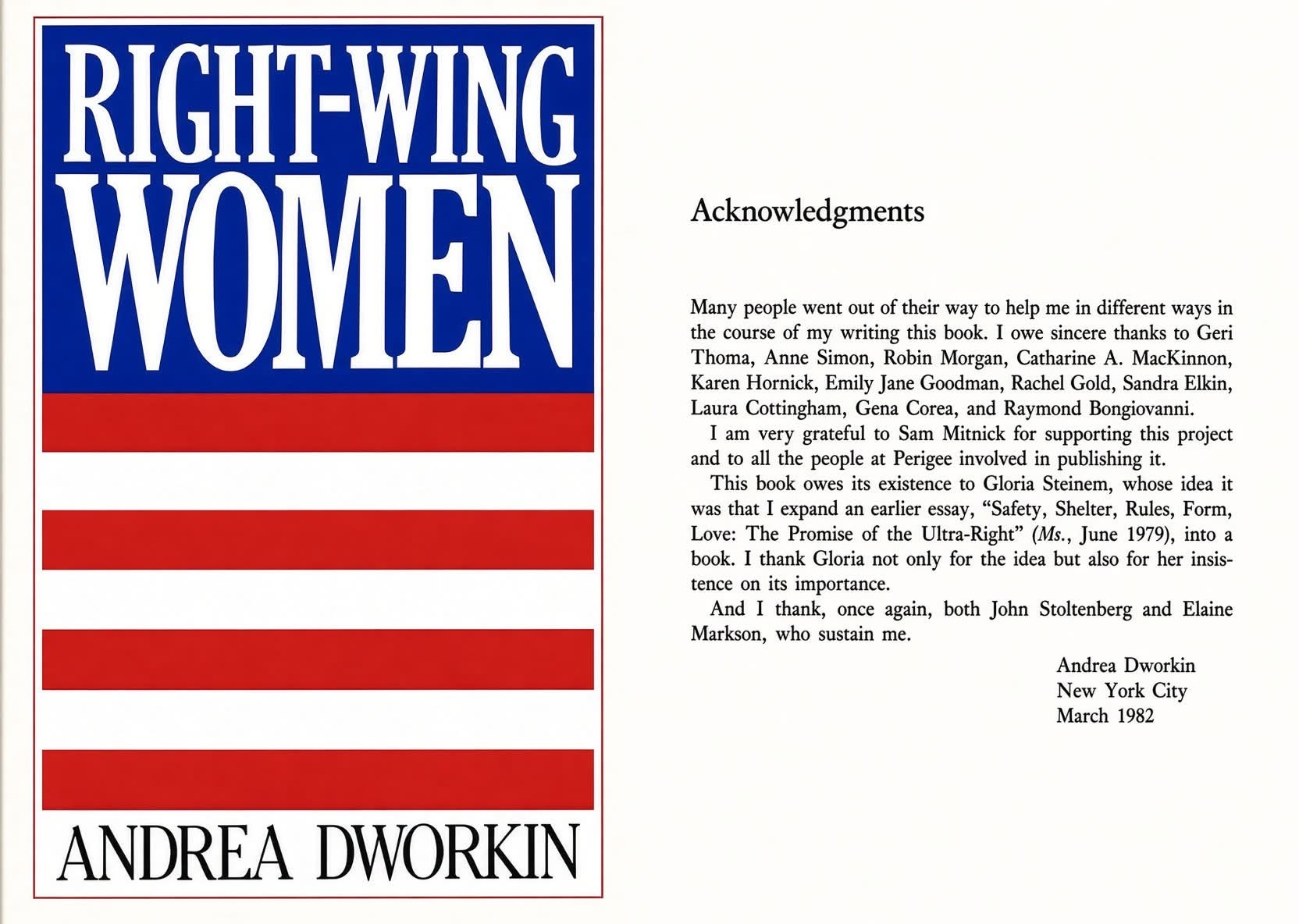
A page after the acknowledgments in Right-wing Women, we see “For Gloria Steinem” and “In Memory of Muriel Rukeyser.”
I will be writing about Dworkin and Steinem, including Duberman’s useful biographical account, Dworkin’s “Phallic Imperialism” in December 1976, and her June 1979 article that became Right-wing Women.
If you are unable to become a paid subscriber through Substack, then please feel free to donate via PayPal, if able. I am grateful for reader support!


Andrea Dworkin to Gloria Steinem, June 18, 1975, qtd. in Martin Duberman, Andrea Dworkin: The Feminist as Revolutionary (New York: The New Press, 2020), 84.
Emmeline Pankhurst, “Address at Hartford” [“Freedom or Death”], November 13, 1913, in Cheryl R. Jorgensen-Earp, ed., Speeches and Trials of the Militant Suffragettes: The Women’s Social and Political Union, 1903-1918 (Cranbury, NJ: Associated University Presses, Inc., 1999), 329.
See Redstockings, Feminist Revolution, 1975 (New York: Random House, 1978). Steinem’s key critic from the Redstockings was its co-founder Ellen Willis, who later became a defender of pornography against radical feminist critics like Andrea Dworkin. See Willis, “The Conservatism of Ms.,” August 1, 1975, in Feminist Revolution, 170-173. See also Willis, “Feminism, Moralism, and Pornography,” Village Voice, October/November 1979, in Nona Willis Aronowitz, ed., The Essential Ellen Willis (Minneapolis: University of Minnesota Press, 2014), 94-100. Interestingly, Willis coined the term “pro-sex feminism,” an early iteration of “sex-positive feminism,” now a widespread liberal ideology defending the sex/gender industries from criticism, especially from radical feminist criticism. See Willis, “Lust Horizons: Is the Women’s Movement Pro-Sex?” Village Voice, June 1981, in EEW, 200-208. I will be doing a further discussion of Willis, including her essay “Radical Feminism and Feminist Radicalism,” which appeared in the summer 1984 issue of Social Text (see EEW, 229-255).
Dworkin to off our backs, May 2, 1980, qtd. in Duberman, 84-85.
Dworkin to Steinem, June 18, 1975, qtd. in Duberman, 83.
See Andrea Dworkin, “Phallic Imperialism: Why Economic Recovery Will Not Work for Us,” Ms., vol. 5, no. 6 (December 1976), 101-102, 104.
Duberman, 95.
See Andrea Dworkin, “Safety, Shelter, Rules, Form, Love: The Promise of the Ultra-Right,” Ms., vol. 7, no. 12 (June 1979), 62-64, 69-72.
Dworkin, March 1982, in Right-wing Women (New York: Perigee Books, 1983), n.p. See also Dworkin, RW (New York: Picador, 2025), xxi.