

Before returning to Janice G. Raymond’s Transsexual Empire (1979) and her Doublethink (2021), I have decided to do a review essay about Jo Bartosch and Robert Jessel’s book Pornocracy (2025). Here is a shortened “blurb” from my review:
Bartosch and Jessel have made an essential contribution to critiquing pornography and how it has shaped our lives from the public to the private in the Internet Age—a vital response. . . . They incisively argue that our toxic connectedness to pornography has led us to disregard women’s humanity and, increasingly, disconnect from our common humanity. . . . With great courage, they call for a reconnection to our stunted humanity, if only we see the changeable—yes—social and political conditions and the possibilities for salvaging moral intelligence within each of us. Writing in the political and intellectual tradition of [Andrea] Dworkin and [Diana E.H.] Russell, they make a cutting, thoroughly documented case for recognizing pornography as a societal harm and working toward reducing its demand. I found myself highlighting so many passages and bookmarking so many pages . . . an invaluable work for understanding pornography’s technological dominion in our time.
At first, I was going to focus on “Pornified Progress” (Chapter VII), specifically the “Transition from Pornography” section and the authors’ critique of transgenderism in relation to pornography. “Pornified Progress” is an especially important chapter because of how Bartosch and Jessel apply radical feminist Mary Daly’s concept of life in a “reversal society.” Examples include, of course, humankind coming from a man rather than a woman, as in the myth of Eve from Adam’s rib—Daly’s provided example—as well as drag, where “artifice is transformed into authentic self-expression and male fantasy is understood to be the very definition of womanhood itself” (p. 99).
Pornocracy traces pornography’s technological dominion in our time and its effects on social and sexual intercourse, with a detailed bibliography worth its weight in notes. In the Orwellian sense, we learn to accept the most artificial as the expression of the most authentic, the negation of bodily integrity as the affirmation of it, and so on. “Everywhere you go there is Doublethink,” as Daly says.1 Rightly, Bartosch and Jessel emphasize pornography’s role as propaganda in socializing us into the sexual ideology of this reversal society: pain as pleasure, sexual submission as sexual liberation.
With such a narrow focus, however, I considered that it would not do justice to the work to discuss only a relatively brief passage and explain no more about it, going the easy way out. In order to treat it with fairness, I have spent time with Pornocracy, learning from Bartosh and Jessel, making some notes on what struck me the most, and writing about it. There is much worth exploring, but I decided to use a review essay format to discuss “Not Your Grandad’s Porn” (Chapter I), “Generation Porn” (Chapter IV), and “Pornified Progress” (Chapter VII).
My intention was to have the review published over a month ago, but my “Sexology’s Fathers” piece with Fairer Disputations came out sooner, and I had a bit more work at home with my father helping at the laundromat and the minimart.
Thank you so much to my readers for your support in subscribing, donating when you can do so comfortably, as whatever always helps, and, of course, sharing my work!
Donovan Cleckley, August 31, 2026

Jo Bartosch and Robert Jessel, Pornocracy (Cambridge, UK: Polity, 2025).
The technology itself legitimizes the uses of women conveyed by it.
- Andrea Dworkin, Pornography: Men Possessing Women2
What Is Pornocracy?
Pornography has become one of the most influential media-based sexual technologies ever developed—and its production, dissemination, and consumption all underscore its unprecedented power of influence. Long before Pornhub reached over 42 billion visits yearly, averaging 115 million users daily, Andrea Dworkin’s Pornography (1981) critiqued pornography in terms of a technology that legitimizes the devaluation and dehumanization of women and girls.3 She wrote her critique toward the end of a period now often known as the “Golden Age of Porn,” spanning from roughly 1969 until 1984—ranging from print to film to video in those decades before today’s online streaming of seemingly endless pornographic content. Pornography was influential at the time, but its form was confined to print magazines like Playboy, Penthouse, and Hustler and films like Deep Throat. While it occupies virtually everywhere, Pornhub did not exist until 2007—and it eclipses its predecessors. These decades later, it seems undeniable how pornography has spread and worsened—or, rather, even further distorted—society’s understanding of women and sex itself. Sexual technologies developed in the past decades bear the mark of pornography’s influence and derive from the social order pornography itself has manufactured, the world pornography has made.
With their Pornocracy (2025), Jo Bartosch and Robert Jessel have made an essential contribution to critiquing pornography and how it has shaped our lives from the public to the private in the Internet Age—a vital response. I am reminded of not only work from Dworkin, in terms of early critiques, but also work from radical feminist sociologist Diana E.H. Russell, particularly her Dangerous Relationships: Pornography, Misogyny, and Harm (1998). They incisively argue that our toxic connectedness to pornography has led us to disregard women’s humanity and, increasingly, disconnect from our common humanity. Reading their Pornocracy, we learn the governing characteristic of the pornocratic order is a dissociated cruelty structured around this suffocating desensitization for the body as the self. With great courage, they call for a reconnection to our stunted humanity, if only we see the changeable—yes—social and political conditions and the possibilities for salvaging moral intelligence within each of us.
Writing in the political and intellectual tradition of Dworkin and Russell, they make a cutting, thoroughly documented case for recognizing pornography as a societal harm and working toward reducing its demand. I found myself highlighting so many passages and bookmarking so many pages that I think it would be impossible to cover everything—all in all, an invaluable work for understanding pornography’s technological dominion in our time. When I get a hard copy someday, I have a feeling that it will be filled with book tabs, as my Books app version is quite thoroughly highlighted and bookmarked. For the sake of (relative) brevity, then, this review will focus on three sections: “Not Your Grandad’s Porn” (Chapter I), “Generation Porn” (Chapter IV), and “Pornified Progress” (Chapter VII).
What is Pornocracy? The authors define “Pornocracy” as the following: “A society in which political power, culture, relationships, and identity are shaped or dominated by the purveyors of pornography” (p. 1). I am reminded of psychiatrist Thomas Szasz’s use of “pharmacracy” in reference to “rule by medicine or physicians.” Pharmacratic and pornocratic societies overlap, where pornography influences medicalization as medicalization influences pornography. We will see this intersection of the pharmacratic and the pornocratic in the chapter titled “Pornified Progress” as manifested in transgenderism and its relationship with pornography. From the introduction, the authors explain: “Over nearly three decades, online porn has trained the mind to see women not as persons, but as costumes to be worn, roles to be assumed” (p. 3). In a 1981 piece titled “Pornography’s Part in Sexual Violence,” Dworkin observed that “in a sex-polarized society men also learn about women and sex from pornography.”4 Men define women’s existence according to pornography; women learn this definition, come to believe it like religious dogma, and enforce it—even at their own expense. With their book, Bartosch and Jessel provide continuing proof that Dworkin was right, yet denialism prevails.
Not Your Granddad’s Porn
How has pornography changed from the 1970s into the 2020s? At one time, pornography was mostly print material—physical and destructible. I think about how Nikki Craft and Melissa Farley engaged in nonviolent civil disobedience in the National Rampage Against Penthouse, invading bookstores and tearing up Penthouse as well as Playboy and Hustler until arrested. Across multiple states, from Dworkin’s account, women attacked pornography displays with their bare hands, with India ink, and even with their blood.5 Pornography was once something that women could physically attack to fight its appearance in supermarkets and spaces of public commerce. But, as Bartosh and Jessel show, pornography evolved both technologically and reputationally. Paradoxically, the uncritical repetition of rhetoric about pornography’s harmlessness coincides with the increasing normalization of extreme sexual behavior in the pornography consumed. Despite the harms, its respectability has given pornography a foothold in politics and in everyday life. The authors use the analogy “that today’s porn is as far removed from your granddad’s centrefolds as a petting zoo is from an abattoir” (p. 6). Pornocracy convincingly shows that sexual violence, incest, and child sexual abuse have become popular consumables for today’s pornographic imagination.
Various content analyses, as referenced by Bartosch and Jessel, document the prevalence of male violence against women in pornography, which includes acts of aggression such as choking, gagging, slapping, and beating. For instance, they cite a 2020 study of 4,009 heterosexual scenes from Pornhub and Xvideos, two major free pornographic websites (p. 9). The results indicated that 45% of scenes in Pornhub and 35% of scenes in Xvideos exhibited acts of aggression: spanking, gagging, slapping, hair pulling, and choking. Women and girls were the target in 97% of them—and men were the perpetrators in 76% of scenes. Further content analyses, as Bartosch and Jessel note, have indicated that—even in scenes where the women initiate sexual activity—men’s sexual desire for the women remains the focus. Pornography involving women committing violence against women typically centers around the man’s sexual pleasure, a Sadeian theme more visible today due to pornography’s greater accessibility. Categories for incest (including “step-porn”) and “barely legal” (or “teen”) have become more popular in recent years than decades ago—and male consumer demand drives the content. These categories follow with the fetishization of violence pervading the material from production to consumption. The authors quote Emily Eve describing what can happen in a filming that features acts of aggression:
I shot scenes where I had to pretend to be dead and let someone rape my dead body. I came home bruised and sometimes a little bloody from the rough scenes. . . . They slapped me and spit on me and called me horrible things. . . . Time after time, I would go home and cry myself to sleep because I feared what the next day would bring. (p. 13)
[See also Matt Fradd, The Porn Myth: Exposing the Reality Behind the Fantasy of Pornography (San Francisco: Ignatius Press, 2017), 68.]
This account illustrates a point, which is how the fetishization of violence is sexually asymmetrical in pornography—that is, in most cases, scenes primarily depict men engaging in violence against women. In pornography, do men pretend to be dead as women rape them to the same extent that women pretend to be dead as men rape them? The fact that men constitute the vast majority of pornography’s consumers and drive its demand is not a case for men being essentially less moral than women, but it certainly raises questions. Why do men overwhelmingly choose to consume pornographic material featuring acts of aggression over material presented without it? Pornographic displays featuring sadism and necrophilia are not required, but the primarily male consumers demand them—and they sell. Bartosch and Jessel reference a statistic from Ofcom indicating that, in May 2023 alone, 10.1 million UK men were visitors to an online service for pornographic content, being 73% of visitors in contrast to women at 3.7 million at 27% of visitors (p. 19). Male sexual behavior is not inherently violent or harmful—“Not all men,” so we hear—but the majority of male viewership for pornography does not come from nowhere. The men who generate the demand for material featuring sadism and necrophilia are the same men who live alongside us—our husbands, our fathers, our brothers, our friends, our coworkers. The authors discuss how pornography’s shift onto “tube sites” like Pornhub has led to it ensnaring consumers to drive more engagement:
A far more troubling explanation is that online pornography, and the more extreme acts it represents, did not become popular by accident. . . . Tube sites deploy sophisticated algorithms designed to ‘mousetrap’ users, surveying and manipulating their preferences and presenting them with ever more extreme content in order to keep them engaged. . . . By exerting control over the user, pornography platforms are not only maximising profits, but helping to shape the sexual and emotional values of its users, helping to normalise pornography and the extreme acts contained within it. (pp. 20-21)
As much as the consumers become accomplices in sexual exploitation, the sex industry relies on manipulating and exploiting its consumers, effectively trapping all parties involved, which makes today’s “Big Porn” distinct from its quaint predecessors of the 1970s. In what now feels like another world, Hustler magazine did an infamous June 1978 cover of a woman’s legs sticking out of a meat grinder with Larry Flynt’s caption: “We will no longer hang women up like pieces of meat.” Hustler was notorious for particularly violent and degrading imagery, but this fetishization of violence was confined to print and finite in distribution. It lacked the same ease of consumption as what now seems like infinite videos circulating on Pornhub and fed to users through algorithms. Far worse material than anything in Hustler can be accessed virtually any time from the phones we hold in our hands. Technology for producing, distributing, and consuming pornography has changed in such a way that Bartosch and Jessel’s analogy makes perfect sense—then versus now, menagerie versus slaughterhouse. With these changes, pornography has become even more accessible to children than in past decades.
Generation Porn
While early radical feminist critiques of pornography in the 1980s, like Dworkin’s work, addressed children as victims of pornographic exploitation alongside women, there is not a specific focus on children as consumers of pornography. Reading Dworkin’s Pornography alongside Bartosch and Jessel’s Pornocracy, one feels a kind of nostalgia for a simpler past in which violent pornography accessible by iPhone was unimaginable rather than predictable. Radical feminists understood how pornography socializes male and female sexuality from childhood to adulthood, but pornography’s grip has tightened with today’s devices. In Pornocracy, the authors discuss how “pornography has become our children’s most trusted teacher, shaping their views on everything from sexual norms to the nature of consent” (p. 52). At one time, the Playboy stash under teenage boy’s beds could be set on fire or ripped to shreds, but today’s pornography tube sites cannot be burned or torn up—and can be accessed from mobile devices.
What facts do the statistics tell us? Bartosch and Jessel reference 2023 research by the Children’s Commissioner indicating that over a quarter of UK respondents viewed pornography by the age of eleven, with thirteen as the average age for their initial viewing of pornographic content. Another study from the British Board of Film classification, as referenced by the authors, showed that two thirds of eleven to thirteen-year-old viewers of pornography unintentionally found it. In addition, also from the Children’s Commissioner, the authors cite 41% of young people seeing porn on Twitter/X, more than via dedicated pornography websites at 37%. Others were Instagram at 33% and Snapchat at 32%, while 30% found pornography through online search engines (p. 54). They note the rise in child sexual abuse offenses committed by children under eighteen, where pornographic material factors overwhelmingly in the violence perpetrated—as if viewing tutorials for sexual abuse. I note the statistics from the authors’ work because they make a thoroughly evidence-based case for how pornography has expanded its market to children and the impact on child development.
From their interview with YES Matters UK founder Gemma Aitchison, Bartosch and Jessel quote her reflecting on children asking variations of this question: “Miss, if she likes being hit in the bedroom then why is it domestic abuse anywhere else?” While sexologists like John Money, for instance, have argued that pornography has no socializing effect on children, reality suggests otherwise, as rigorously documented in Pornocracy. Here is Aitchison, as interviewed:
When discussing consent, girls describe ‘breath play,’ which is strangulation, and ‘love bruises,’ which are physical injuries from assault during sexual activity. They claim that to not do these things is ‘vanilla,’ which means you’re boring and bad at sex, which is something they don’t want to be labelled. (p. 53)
Prior literature critical of pornography, including Dworkin’s analyses, did not have to contend with such a rise in strangulation during sexual activity for those under eighteen, as seen in recent years. A study from the Institute for Addressing Strangulation (IFAS), for instance, has shown 43% of sexually active sixteen- and seventeen-year-olds have experienced this practice euphemized under “kink.” Nearly a third surveyed wrongly believed there is a safe way to strangle a partner, while 36% reported fear during the practice, and 21% reported experiencing dangerous symptoms like dizziness and loss of consciousness.6 Unsurprisingly, across the statistics, the ones doing the strangling are overwhelmingly male as the ones being strangled are overwhelmingly female—a duality taught in pornography of male as subject and female as object. Even if one accepts that pornography can be “safe” for adults, its role in socializing children as they enter adolescence and grow into adults seems hardly without consequence for the wellbeing of the individual and the society.
What Bartosch and Jessel document in their book is essential to recognizing the sexual trouble facing “generation porn.” Yet denialism persists about the extent of the problem and how so-called “fantasy” has translated into reality. As the content of the pornographic material has become more extreme, the expectations for sexual behavior have shifted in that direction among children in their ongoing exposure to pornography. The authors critique “queer theory” and how its founding theorist Gayle Rubin frames age of consent as “erotic injustice” (p. 66). I would add that Rubin’s concern was on behalf of pederasts/“boy-lovers,” particularly the gay men involved with the North American Man/Boy Love Association (NAMBLA).
“Child sexual abuse is a crime of darkness: it occurs in secret and the victims are usually coerced or manipulated into silence,” the authors write (p. 65). Pornography as part of children’s everyday lives should register as extraordinary, a scandal of a generation progressively groomed, but it has become ordinary. This indoctrination has to do with the distortions that society has accepted to rationalize the irrational. Bartosch and Jessel reference a 2005 paper from Tony Ward and Anthony Beech, titled “An Integrated Theory of Sexual Offending,” that discusses prior research from Ward et al. about “cognitive distortions” rationalizing child sexual abuse (p. 66).7 A familiar theme, as seen in the research, has been that “children are sexual beings and that sex does not cause harm to children.” This view prevails in “queer theory,” à la Rubin, and contemporary “sex positivity,” as authors discuss in detail—although it has its roots in twentieth-century sexology in the work of Alfred Kinsey and John Money.
Every system of exploitation relies on a wider network of enablers: There are some who do the exploiting and many who enable the exploitation. There is a brilliant passage from Bartosch and Jessel reminiscent of the second-wave feminist analysis in Florence Rush’s 1980 book The Best Kept Secret: Sexual Abuse of Children:
The most dangerous secrets are the ones we keep from ourselves. For decades, our society refused to acknowledge the obvious dangers of children’s easy access to increasingly extreme pornography. For some people, perhaps, it was because admitting it would force them to confront the evil of their own addiction. Whatever the reason, a generation of young people have become ensnared by porn, yet this crisis goes almost unremarked by politicians, parents, or the public at large. The painful truth is that the Pornocracy has succeeded for the same reason that so many child abusers get away with it for so long: because enough people in power decided to turn a blind eye. (p. 67)
Bartosch and Jessel make an important point here that, historically, abuse has transpired and persisted because of the unsurprising preference to look away, not wanting to look unkind. Instead of confronting the sexual abuse of children, our narcissistic and indoctrinated culture prefers continuous affirmation rather than uncomfortable conversation. So much of society lives in denial about how pornography socializes human sexuality and, perhaps even more, too many deny its very obvious influence on children’s development.
Pornified Progress
This chapter begins with radical feminist Mary Daly’s theory of reversals, and Bartosch and Jessel note artificiality into authenticity, male fantasy as what defines female humanity, among today’s examples. “Progress” for those who consider themselves “liberal” has become synonymous with varieties of prostitution. As Bartosch and Jessel put it well:
The right side of history has become somewhat crowded. Today, those who consider themselves liberals commonly share a host of beliefs not historically associated with the left. These include the idea that couples ought to have the right to use surrogate mothers to start families, that transwomen are women and that sex work is work. As we’ll explore in this chapter, we believe these viewpoints are pornogenic. (p. 98)
At the start of the section titled “Transition from Pornography,” Bartosch and Jessel quote a man named Juno Roche describing his desire for a “vagina” of his own. They quote part of his piece about his “sexual dreams” of being penetrated, but I have included more here to illustrate even more what motivated the man’s “transition” to “womanhood”:
Our vaginas are different, unexplored, created, surgical, magical, mysterious, and too often untouched by outsiders. I spent many years dreaming about mine, imagining how it would feel to reach down and discover an opening, to feel right. I had sexual dreams about having a vagina from my teenage years onward. I dreamed that a hand would slide into my knickers and find a moist slit. That a finger would push in and then a phallus—plastic or real, would push in slowly and deeply and make me gasp. I carried on dreaming that dream until the night before surgery. The same faintly naive dreams that my vagina would work like any natal female’s.8
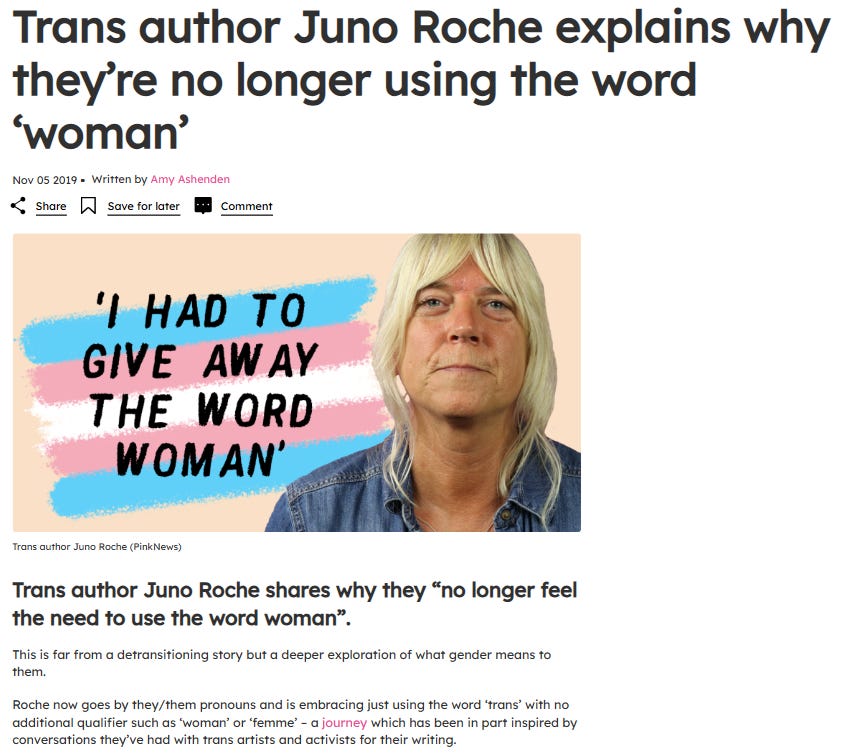
Not just a random man buying a “vagina” of his own, Roche happens to be a “trans author,” a notable activist, who has written books like Queer Sex: A Trans and Non-Binary Guide to Intimacy, Pleasure, and Relationships (2018); Trans Power: Own Your Gender (2019); and Gender Explorers: Our Stories Growing Up Trans and Changing the World (2020). Although Bartosch and Jessel do not quote it, there was a comparably awful, though now deleted, piece Roche wrote about purchasing his “pussy,” being “new and unused”—in his words, “open for business or love”:
Something that I didn’t take into account when I underwent gender confirmation surgery was my age. Already in my 40s, I emerged, like a bouncing newborn, with my new vagina at the ready. I was starting again but my body, my intimate body, would now be a thing to display, to share and not to hide. I could, so to speak, ‘put it about’ if that’s what I wanted to do. So I never gave my age any second thoughts. I presumed, rather naively, that the world would be right there with me, holding my hand and exploring my pertness. I readied myself with great lingerie; matching, sheer, lacy and barely there. Thongs so slight they became lost between my legs, like a cave-dive guide rope. I strode out purposefully, sexuality ready, as soon as I healed and declared to the world, ‘I’m here, I’m ready, I’m luscious, I’m open for business or love—you pick, I’ll decide.’ And then, like rain on my parade, the world kept walking by, not noticing, not caring, not responding. The harder I flirted—eyes, lips, hair flicked back—the more deafening the silence. It was only after I had my pussy that I realised my body was that of a middle-aged woman. There was an age difference between me and my vagina. My vagina was new and unused and I was forty-five.9
This passage underscores the point, as if it needed any further proof. To quote Bartosch and Jessel: “What is referred to as ‘trans’ is a hypersexualised fantasy: it lures some males to identify as women, and terrifies some females into identifying as male or non-binary” (p. 100). Interestingly, Roche later expressed going by “they/them” pronouns because “trans” is a “journey,” and body parts, of course, can be rearranged according to fantasy and desire.
Male “transition” narratives about buying their own so-called “female” genitalia to consummate their desire for “womanhood” sound eerily similar to male sex buyers who buy women in prostitution. Men happen to buy sexual access to womanhood in a variety of ways, and women remain the objects of commerce. Bartosch and Jessel argue that, while “trans rights” may take a guise of “civil rights,” its pornification complicates the story, evident throughout narratives of “transition.” Roche is an example from a genre of men buying women’s body parts. Men who buy surgically manufactured (so-called) “vaginas”—and women who buy surgically manufactured (so-called) “penises,” for that matter—fetishize the opposite sex’s genitalia to an extreme degree in this overlap between the pornocratic and the pharmacratic.
If Roche was too obscure an example, Bartosch and Jessel reference Andy/Andrea Long Chu, who has written about how “sissy porn” can influence male “transition” in terms of male sexual desire for a pornographic image of “femaleness.” Bartosch and Jessel quote, “Getting fucked makes you a woman because fucked is what a woman is,” but there is a bit more in Chu’s talk worth quoting here for readers:
Getting fucked makes you a woman because fucked is what a woman is. Penetration confers femaleness. This distinguishes sissy porn’s theory of anal sex from that of the gay male barebacking subculture Tim Dean describes in his book Unlimited Intimacy. There, writes Dean, ‘being sexually penetrated is a matter of ‘taking it like a man,’ enduring without complaint any discomfort or temporary loss of status, in order to prove one’s masculinity.’ Even in barebacking, masculinity remains the ultimate condom. But sissies never use protection, latex or otherwise. While it borrows some of barebacking’s terminology—notably the term breeding, which Dean glosses as ‘the deliberate abandonment of condoms as an attempt to conceive’—sissy porn depicts anal penetration as a full-scale assault on not just masculinity, but manhood as such.10 (emphasis added)
This 2018 talk “Did Sissy Porn Make Me Trans?” was an earlier version of Chu’s 2019 Females, but the ideas remain essentially the same. Popular male “transition” narratives typically emphasize a kind of “asexual” development of “identity,” but reality indicates the opposite: Male sexual desire strongly determines these men’s desire for womanhood. Pornography happens to be these men’s reference for womanhood. Let us recall the quote from Roche: “I dreamed that a hand would slide into my knickers and find a moist slit.” Without giving away the entire section, I find that Bartosch and Jessel provide readers with a piercing look into how transgenderism’s rise coincides with pornography’s technological dominion.
Resisting the Pornocracy
I have drawn the connections to Dworkin’s 1981 book Pornography because Bartosch and Jessel’s Pornocracy is an important theoretical development in this body of literature. Unfortunately, what pornography was then has become worse now with technological developments that make the world into a “pornopticon.” There is significantly more online exposure for not only adults but also children, which has any number of consequences on individual sexual development relative to social development.
While Bartosch’s interests are more in the social and the political, Jessel emphasizes more explicitly the moral responsibility of the individual. Responses from both authors bring to mind related concepts from Dworkin: moral intelligence and sexual intelligence. Here is the passage from Right-wing Women (1983):
Moral intelligence is characterized by activity, movement through ideas and history: it takes on the world and insists on participating in the great and terrifying issues of right and wrong, tenderness and cruelty. . . . There is also, possibly, sexual intelligence, a human capacity for discerning, manifesting, and constructing sexual integrity. . . . Sexual intelligence would probably be more like moral intelligence than like anything else: a point that women for centuries have been trying to make. But since no intelligence in a woman is respected, and since she is condemned to moralism because she is defined as being incapable of moral intelligence, and since she is defined as a sexual thing to be used, the meaning of women in likening moral and sexual intelligence is not understood. . . . Sexual intelligence constructs its own use: it begins with a whole body, not one that has already been cut into parts and fetishized; it begins with a self-respecting body, not one that is characterized by class as dirty, wanton, and slavish; it acts in the world, a world it enters on its own, with freedom as well as with passion.11
Responding to pornography, social and political change as well as the capacity for change within the individual have to do with the exercise of moral intelligence in relation to sexual intelligence. There is a protective measure, as Bartosch notes, women separating themselves from men who rely on pornography—much easier said than done, of course, but necessary in women asserting basic self-respect. Women’s organized resistance to pornography, partly discussed here in this review essay, indicates possibilities for renewed women’s consciousness and protest.
From Bartosch to Jessel, there is a shared call for us to have a higher sense of our relations with each other, “that there is something richer and more satisfying than wanking to women’s pain, or having ‘sex’ with a dead-eyed silicone doll” (p. 145). The human element in sexual desire has been lost as technology has colonized it, and, as Pornocracy shows, many women pay with their lives and their bodies. How to rediscover our humanness, also easier said than done, demands conscious opposition to fetishism’s dismemberment of the body and re-vitalizing our self-respect.
Pornocracy is difficult because it can be hard to face reality, easier to pretend that pornography is about freedom. Likewise, it would be less difficult to nod along to men as women and women as men, also strategically marketed as freedom. But, if there is one lesson we learn from Bartosch and Jessel, it is to hold onto our humanity in pornography’s dystopia and see beyond the reversal society. I believe that women and men can practice moral intelligence as well as sexual intelligence and that integrity of the body can triumph over its degradation.
If you are unable to become a paid subscriber through Substack, then please feel free to donate via PayPal, if able. I am grateful for reader support!

Mary Daly, “Interview,” Philosophy Now (September/October 2001), 17.
Andrea Dworkin, Pornography: Men Possessing Women, 1981 (New York: Picador, 2025), 192.
For these figures, see Pornhub, “2019 Year in Review,” https://www.pornhub.com/insights/2019-year-in-review. Interestingly, Pornhub’s recent years in review have not provided numbers for Pornhub’s website traffic like in 2019, but the upward trend from previous years suggests an increase. See Pornhub, “2025 Year in Review,” https://www.pornhub.com/insights/2025-year-in-review.
Andrea Dworkin, “Pornography’s Part in Sexual Violence,” 1981, in Letters from a War Zone, 1988 (New York: Lawrence Hill Books, 1993), 209.
Dworkin, “Pornography’s Part in Sexual Violence,” 206.
Robyn Vinter, “Nearly Half of Sexually Active Young People in UK Have Experienced Strangulation, Study Shows,” The Guardian, November 17, 2025, https://www.theguardian.com/society/2025/nov/18/sexually-active-young-people-uk-choking-strangulation-sex.
Tony Ward and Anthony Beech, “An Integrated Theory of Sexual Offending,” Aggression and Violent Behavior, vol. 11, no. 1 (January-February 2006), 44-63, https://doi.org/10.1016/j.avb.2005.05.002. See also Tony Ward, Stephen M. Hudson, Lucy Johnston, and William L. Marshall, “Cognitive Distortions in Sex Offenders: An Integrative Review,” Clinical Psychology Review, vol. 17, no. 5 (1997), 479-507, https://doi.org/10.1016/S0272-7358(97)81034-3; Tony Ward and Thomas Keenan, “Child Molesters’ Implicit Theories,” Journal of Interpersonal Violence, vol. 14, no. 8 (August 1999), 821-838, https://doi.org/10.1177/088626099014008003.
Juno Roche, “How I Feel About My Vagina, as a Trans Woman,” Refinery 29, August 21, 2016, originally published as “Other Lands,” The Queerness, August 1, 2016, qtd. in Bartosch and Jessel, 99. Here is the link: https://www.refinery29.com/en-gb/transgender-vagina-surgery.
Juno Roche, “When It Comes to Beauty, Older Women Just Can’t Win,” Refinery 29, February 21, 2017, https://web.archive.org/web/20170223100156/http://www.refinery29.uk/society-beauty-standards-older-women.
Andrea Long Chu, “Pornographic Spectatorship, or, Did Sissy Porn Make Me Trans?” Paper presented at the 2018 annual meeting of the American Comparative Literature Association, UCLA, Los Angeles, CA, March 29-April 1, 2018; also presented at the Queer Disruptions 2 conference at Columbia University, New York, March 1-2, 2018. See the PDF of “Did Sissy Porn Make Me Trans?” via The Transfeminine Review: https://thetransfemininereview.com/wp-content/uploads/2024/08/8bf93-chu-didsissypornmakemetrans3f28qd229.pdf.
Andrea Dworkin, Right-wing Women, 1983 (New York: Picador, 2025), 42-44.
Wonderful piece!
I *know* that this affects children. I've seen the behavior of some children and I can tell that some of them have unrestricted internet access. It's neglect and it breaks my heart.