This post includes remarks from the February 11 session about Janice G. Raymond’s work on transsexualism and transgenderism, available on YouTube, and a transcription of it, with additional notes. I became a bit ill and had a conference presentation on February 28, so much life got in the way. Over the past month has been me doing what I wanted to do by the end of February into March.
At first, I wanted to do the talks as X spaces, but I have decided on just recording commentaries separately and posting them. Part of the reason has been that I spend most days helping my father at the laundromat and the minimart he and my mother opened before she died in December 2024 from sepsis after surgery over hernia mesh complications. The other part has been my health. The scheduling of the spaces has grown to be difficult, apart from editing the audio together, cutting or adding some commentary, and formatting the transcription. My strained relationship with technology for my writerly ends is Sisyphus and his stone. Depending on interest, I may decide to do more X spaces that are more general discussions as opposed to sessions focusing on specific texts. However, at this point, it does not make sense to do a live session every week or even every other week.
Following this session, there will be a shorter recording for another talk discussing German-Jewish sexologist Magnus Hirschfeld and his Institut für Sexualwissenschaft (Institute for Sexual Science). This discussion will include Hirschfeld’s collaboration with Erwin Gohrbandt in the first cases of surgical “sex conversion” on Dora Richter and Lili Elbe. Following his work with Hirschfeld’s Institute from the early 1920s into the early 1930s, Gohrbandt became a high-ranking Nazi doctor by the late 1930s.
Despite Hirschfeld’s influence, Raymond’s 1979 Transsexual Empire only discusses him on exactly one page in which she references Harry Benjamin writing that the Nazis targeted Hirschfeld’s Institute because its “confidential files were said to have contained too many data on prominent Nazis, former patients of Hirschfeld” (see TE, p. 152). Apart from critiquing John Money, Raymond primarily focuses on noted “father of transsexualism” Benjamin, who authored The Transsexual Phenomenon in 1966. Closer analysis of Hirschfeld’s work would give us a clearer understanding of how his work influenced Benjamin and Money as successors who far advanced transsexualism.
Some of this information appears in the present talk as I construct a historical background to accompany Raymond’s analysis.
I apologize for the difficulties in getting everything done, as I have wanted to do more, but life is not always as I wish it were.
Donovan Cleckley, April 9, 2026
Sessions
Session I—January 28
TE, “Introduction to the 1994 Edition” (pp. xi-xxxv)
TE, “Introduction. Some Comments on Method (for the Methodical)” (pp. 1-18)
D, “Introduction. From Transsexualism to Transgenderism” (pp. 1-20)
Session II—February 11
TE, “Chapter I. ‘Everything You Always Wanted to Know About Transsexualism’” (pp. 19-42)
D, “Chapter II. The Rapid Rollout of Transgenderism: How Did It Happen?” (pp. 55-86)
Session III
TE, “Chapter II. Are Transsexuals Born or Made—or Both?” (pp. 43-68)
D, “Chapter I. The New Trans Biologism: Female Brains and Female Penises” (pp. 21-54)
Session IV
TE, “Chapter III. ‘Mother’s Feminized Phallus’ or Father’s Castrated Femme?” (pp. 69-98)
D, “Chapter III. Self-Declared Men, Transitioning and De-Transitioning” (pp. 87-121)
Session V
TE, “Chapter IV. Sappho by Surgery: The Transsexually Constructed Lesbian Feminist” (pp. 99-119)
D, “Chapter IV. The Trans Culture of Violence Against Women” (pp. 123-154)
Session VI
D, “Chapter V. Gender Identity Trumps Sex in Women’s Sports and Children’s Education” (pp. 155-181)
Session VII
TE, “Chapter V. Therapy as a Way of Life: Medical Values versus Social Change” (pp. 120-153)
TE, “Chapter VI. Toward the Development of an Ethic of Integrity” (pp. 154-177)
Session VIII
D, “Chapter VI. The Trans Gag Rules: Erasing Women, Pronoun Tyranny, and Censoring Critics” (pp. 183-221)
Session IX
TE, “Appendix. Suggestions for Change” (pp. 178-185)
D, “Conclusion” (pp. 223-233)
KEYWORDS
Janice G. Raymond, The Transsexual Empire, Doublethink, transsexualism, transgenderism, sex-role stereotyping, “sex-conversion surgery,” Harry Benjamin (The Transsexual Phenomenon), Magnus Hirschfeld, George/Christine Jorgensen, Christian Hamburger, Rita/Reed Erickson (Erickson Educational Foundation), Harry Benjamin International Gender Dysphoria Association (HBIGDA)/World Professional Association for Transgender Health (WPATH), John Money, “transgender child” industry, “gender-affirming care,” “transition or die”/suicide threat, pornography (“sissy porn”/“forced feminization”), men’s fetishization of women, “men possessing women” (Raymond and Dworkin), cultural appropriation of lesbianism, institutional capture/stifling of debate, “illusion of inclusion” (Raymond)
CLECKLEY (Voiceover): Hello. My name is Donovan Cleckley. This YouTube video includes text from my X space, dated Wednesday, February 11, discussing the work of Janice G. Raymond on transsexualism and transgenderism. It is Session II of a small planned series of readings and discussions of Raymond’s 1979 book The Transsexual Empire: The Making of the She-Male and her 2021 follow-up titled Doublethink: A Feminist Challenge to Transgenderism. This session discusses chapter one from The Transsexual Empire, titled “‘Everything You Always Wanted to Know About Transsexualism,’” in quotation marks, and chapter two from Doublethink titled “The Rapid Rollout of Transgenderism: How Did It Happen?”—both interestingly discussing men’s fetishization of women. I have chosen to pair chapters of Raymond’s Transsexual Empire in order with differing chapters from Doublethink that correspond with similar themes.
After the X space on February 11, I was a bit sick, so my voice was in some recovery to avoid recording commentary in poor quality. Plus, on February 28, I presented a paper discussing the French novelist Colette and radical feminist Andrea Dworkin, an opportunity that I enjoyed. I will see about getting text from that presentation up with some audio in the coming days as a break from the present book series discussing Raymond’s Transsexual Empire and Doublethink. Meanwhile, I have been unhappy with the social media suppression, especially on platforms like X, where I may as well be writing letters to a fireplace. It is not a “memory hole” in the truest sense of nothingness, as in Orwell’s novel, but shadowbanning functions to isolate writers and diminish voices, social conditions that smash intelligence to pieces. My experience on X has been that it does not prove useful unless one generates the intellectual equivalent of “junk food” as content, which excludes serious political analysis. I have noticed that the monetized accounts who get the most shares often have the least informative posts that rely on varieties of clickbait, sensationalized misinformation, and recycling others’ content.
For this session about The Transsexual Empire and Doublethink, I have reduced the length with a sharper focus on a few key points from the chapters and some commentary rather than attempting more of a comprehensive review. This session and later ones will follow a similar format to emphasize certain passages and lessen the overall time spent covering everything. Because I did a lot of editing on the text for this one, including some additions, I am planning to do most of the talks recorded without being X spaces. I may plan spaces to do some broader discussions of material, but I think the effort put into spaces can be more strategically applied to recording audio versions of some written content. Thank you all so much for listening.
Chapter I—“‘Everything You Always Wanted to Know About Transsexualism’”
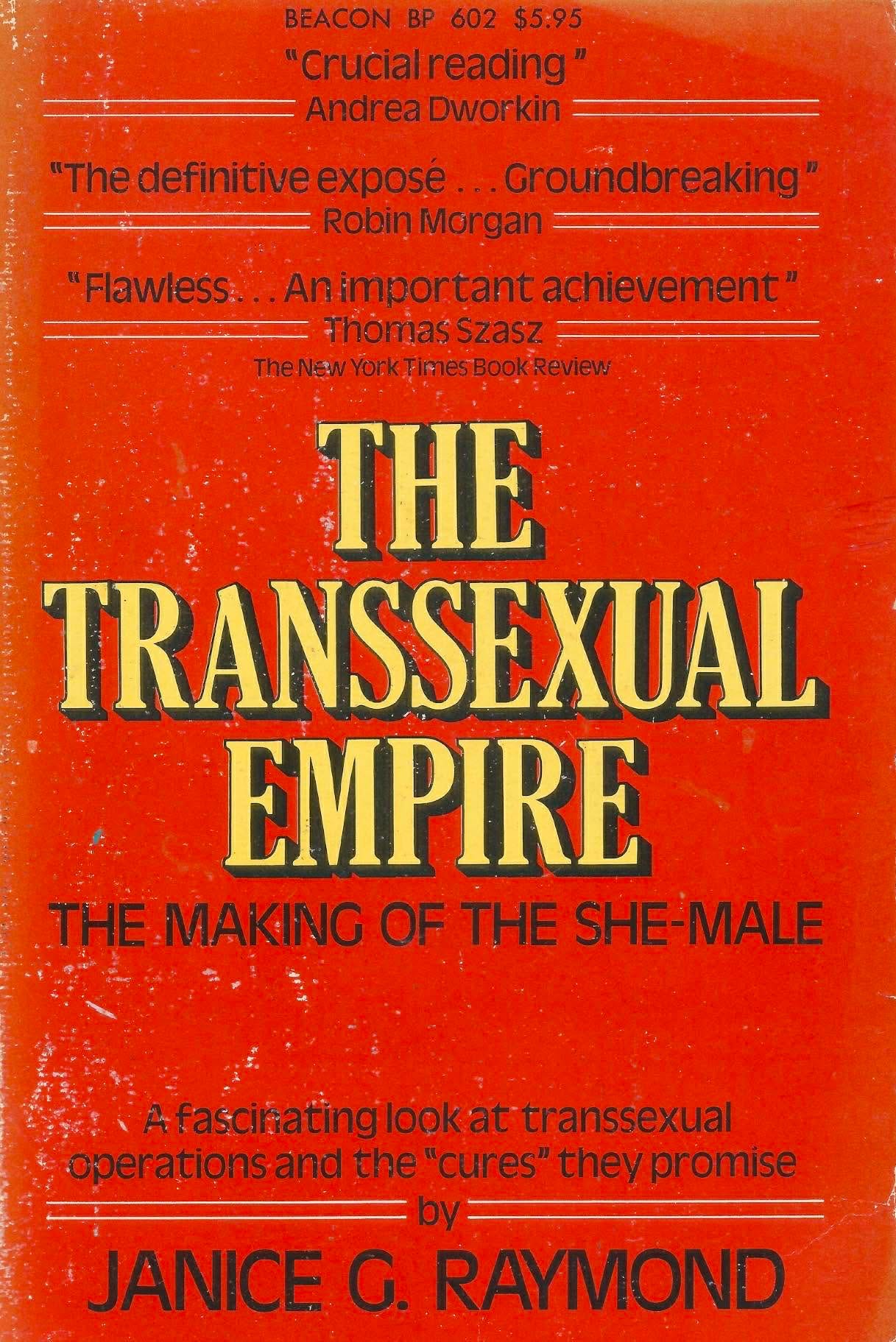
CLECKLEY: This chapter in Raymond’s Transsexual Empire, humorously titled “‘Everything You Always Wanted to Know About Transsexualism,’” in quotation marks, covers some information regarding transsexualism, some now more widely recognizable. Modern sex-conversion surgery, she explains, dates back to the early 1930s. Hormonal and surgical techniques remained in development, not widely publicized until the early 1950s. When the New York Daily News ran a front-page story with the headline “Ex-GI Becomes Blonde Beauty” on December 1, 1952, George/Christine Jorgensen’s widely publicized case inspired men’s initial demands for “sex change” in the United States. Sensationalized media coverage followed Jorgensen’s return from Denmark, where he underwent surgical interventions to modify his male body into a simulacrum of “femaleness” made by male surgeons for their male patient. Men saw this ordinary-looking ex-GI become his own so-called “blonde beauty,” and they figured they could become the women of their own fantasies. Achieving widespread publicity into 1953, Jorgensen’s case demonstrates how the marketing of trans ideology in the media began much earlier than often acknowledged.
Transsexualism’s early support came from German-American sexologist Harry Benjamin (1885-1986), known as “the father of transsexualism,” who did the pioneering study of transsexualism in his 1966 Transsexual Phenomenon. The Erickson Educational Foundation (EEF) and Johns Hopkins University were significant in transsexualism’s early institutional support. Rita Erickson (1917-1992), known as “Reed Erickson,” was a wealthy female philanthropist, a trans-identified female, who funded the EEF, which had an office in Manhattan from 1967 to 1976. In her interviews for The Transsexual Empire, Raymond spoke with EEF associate director Zelda R. Suplee (1908-1989). We will be talking some about Suplee and her responses to Raymond’s questions. An interesting fact about the EEF is that its decline had to do with Erickson’s own continuing problems with drug addiction during the 1970s. She eventually fled to Mexico in 1983 following her arrest for possession of cocaine. Erickson’s drug addiction persisted despite her wealth that funded not only her social and medical transition but also resources for others desiring similar medicalization.
From 1964 until 1977, Erickson’s foundation was active, briefly reviving between 1981 and 1984, until permanently closing. It was not a consistent source of financial support for what was, at the time, so-called “transsexual rights activism.” When the EEF ended most of its operations in 1976, Suplee closed her New York office and relocated to Galveston, Texas, where she then directed the Janus Information Facility (JIF), which was a referral service for transsexual patients. It was affiliated with the University of Texas Medical Branch, directed by Dr. Paul A. Walker (1946-1991), a gay male sexologist who later died of complications from HIV/AIDS. Walker was the founding president of the Harry Benjamin International Gender Dysphoria Association (HBIGDA) in 1979, rebranded to the World Professional Association for Transgender Health (WPATH) in 2011.
As Raymond discusses, transsexualism originated as a popular medical term into the early 1950s when the U.S. sexologist D.O. Cauldwell (1897-1959), in a 1949 issue of Sexology, used it to describe the case of a young woman who desired to be male. Raymond does not give us more information about the case other than saying that Cauldwell used “psychopathia transsexualis” “to classify a girl whom he described as obsessively wanting to be a boy” (TE, p. 20). When I read his report, I noticed that Cauldwell described a young woman, who had turned eighteen, coming from a difficult family background, who liked other women and disliked wearing “feminine attire.” He refers to her as “Earl,” not her name but, he explains, is like hers in that it “is frequently borne by members of both sexes.”
Interestingly, Cauldwell strongly opposed Earl’s desire that he find her a surgeon to remove her breasts and her ovaries, surgically close her vagina, and “create for her an artificial penis.” Even though she was of legal age, he considered it criminal to do so. How others saw her was her obsession, loving to be seen as “male” and “immensely happy” once when mistakenly called “Sir.” Earl did not like working but remained economically dependent on her family, despite her family not being wealthy enough to support her. Cauldwell notes there was an “expression of death-wishes” that annoyed him and his wife, presumably that Earl talked regularly of suicidal ideation to draw sympathy. Later, we will return to Earl’s case for more in-depth analysis, but it presents a significant difference from cases like George/Christine Jorgensen’s and those of married heterosexual males like James/Jan Morris. I note the case here because it reaffirms Raymond’s analysis in Transsexual Empire and foreshadows later developments that she discusses in Doublethink.
Following Cauldwell’s 1949 report, Harry Benjamin, who met the German-Jewish sexologist Magnus Hirschfeld (1868-1935) in about 1906 or 1907, used transsexualism during a 1953 lecture to the New York Academy of Medicine. In fact, Benjamin’s first published use of transsexualism was in a 1953 article “Transvestism and Transsexualism,” first printed in The International Journal of Sexology. Sources like The Transgender Studies Reader, in 2006, claim an earlier origin in Hirschfeld’s use of the term seelischer Transsexualismus, or “psychic transsexualism,” in 1923 (see TSR, p. 23). Terminology like “transsexualism,” however, would not become mainstream until the early 1950s following Cauldwell and Benjamin. At the same time, coverage of the Jorgensen case, which began in December 1952, continued into 1953.
According to Raymond, the first physician to perform transsexual surgery was F.Z. Abraham (1901-1937), in 1931, who reported the first case of “sex-conversion surgery.” Raymond’s note includes the following reference: F.Z. Abraham, “Genitalumwandlung an zwei maennlichen Transvestiten,” Sexualwiss, 18 (1931): 223-26. In 1998, The International Journal of Transgenderism published an English translation of the article titled “Genital Reassignment on Two Male Transvestites.” Upon further research, I discovered that Abraham was among the first physicians involved with so-called “sex change.” Given more recent archival research, we know there were others: Ludwig Levy-Lenz (1892-1966), Erwin Gohrbandt (1890-1965), and Kurt Warnekros (1882-1949). Abraham names Levy-Lenz and Gohrbandt in his 1931 article discussing “vaginoplasty” for two distressed male transvestites. They performed the earliest modern “sex change” in the form of “vaginoplasty” on patients that included Einar Wegener (1882-1931), known as “Lili Elbe,” Arno Ebel (1881-1961), known as “Toni Ebel,” and Rudolf Richter (1892-1966), known as “Dora Richter.”
Referenced by Raymond, Abraham’s article mentions Richter and Ebel in the two initial cases but not Wegener, yet we know Wegener’s surgeries occurred in 1931, the same year he died from complications. Weeks after Grohbandt performed “vaginoplasty” on Richter, Warnekros performed a fifth surgery on Wegener on June 17, 1931, involving a “vaginoplasty” and uterus transplant, which led to organ rejection, infection, and death from cardiac arrest on September 13, 1931. Gohrbandt’s role in Wegener’s “transition” was the removal of his testicles when Wegener was at Hirschfeld’s Institute in Berlin in 1930. In Richter’s case, Gohrbandt performed the orchiectomy in 1922 in his collaboration with Hirschfeld’s Institute. With the assistance of Levy-Lenz, in 1931, he also performed the penectomy and vaginoplasty on Richter. After performing these pioneering “transsexual” operations on patients in the 1920s and early 1930s, Gohrbandt became a high-ranking medical authority under the Nazi regime by the late 1930s. He was involved with subjecting prisoners in the Dachau concentration camp to freezing experiments, with findings published in 1945.
Interestingly, Hirschfeld and Levy-Lenz, Gohrbandt’s former colleagues at Hirschfeld’s Institute, were both Jewish, despite their early involvement with a man who became a prominent Nazi figure after pioneering “sex change.” Later in The Transsexual Empire, Raymond notes the connection to Nazi medical experimentation, including a case of a thirteen-year-old boy whom “the scientists of Auschwitz” subjected to “sex change” (see TE, p. 152). However, she does not name Gohrbandt, as the documentation was not as readily accessible in the 1970s, typically not translated from the original German. There is now a more complex and complete picture featuring this pioneer of “sex change” collaborating with Hirschfeld, a Jewish gay man, in the early 1930s, and then becoming a prominent Nazi by the late 1930s. In his Transsexual Phenomenon, Harry Benjamin, who visited Hirschfeld from the early 1900s into the early 1930s, suggested that “prominent Nazis” were among Hirschfeld’s patients treated for sexual abnormalities. On the Nazi destruction of Hirschfeld’s clinic, he said, “The Institute’s confidential files were said to have contained too many data on prominent Nazis, former patients of Hirschfeld, to allow the constant threat of discovery to persist” (TP, p. 12; see also TE, p. 152). Antisemites scapegoated Hirschfeld, both Jewish and homosexual, for their hidden sexual perversions, projecting their pornography and their repressed desires. If Benjamin was right that prominent Nazis were Hirschfeld’s patients, then the narrative becomes complicated. To no surprise, the Nazis were not pure, as they insisted, but as impure as their antisemitic caricatures of the Jews. Contemporary fixation on Hirschfeld’s Jewishness and homosexuality demonstrates more of the same psychosis.
From 1931 to 1952, as Raymond notes, medical experimentation occurred primarily in Germany and Switzerland developing the modern surgical and hormonal treatments euphemized as “sex change.” She notes that Jorgensen’s surgeon Christian Hamburger (1904-1992), a Danish endocrinologist, “seems to have been the first to make use of hormonal castration and to follow up on his patients” (TE, p. 21). Far less known than fellow German-American endocrinologist Harry Benjamin, Hamburger is responsible for the development of the modern clinical approach for surgical and hormonal treatments for transsexualism and transgenderism. In his 2013 biography of Christine Jorgensen, Richard F. Docter discusses how Hamburger “gained considerable professional stature and recognition for his exceptional leadership in the Jorgensen case, and that he was proud of his pioneering work”: “He is seldom credited with being the inventor of the modern protocol for transsexualism but he was” (Becoming a Woman, 2013, p. 90). In fact, Jorgensen, whose birth name was George, chose “Christine” in honor of the man who performed his “sex change”: Christian. Following the early experiments at Hirschfeld’s Institute on Wegener and Richter, it seems worth emphasizing that we lack a record of medical professionals doing extensive follow-up studies on their patients. There were about two decades of surgical attempts with relative lack of care over whether or not the patients were physically and mentally stable in the long term following these experimental surgeries.
By the late 1950s, in New York, Harry Benjamin used funding from Erickson Educational Foundation (EEF) grants for treating so-called “transsexual” patients, culminating in his book-length study published as The Transsexual Phenomenon in 1966. Raymond notes that Benjamin, as “the father of transsexualism,” is the key figure in the U.S. who gave transsexualism psychiatric and medical legitimacy. Over a decade before HBIGDA came into existence in 1979, with its rebrand to WPATH in 2011, Erickson’s foundation provided funding for the Harry Benjamin Foundation in 1964. It brought together more professionals to do more research, which included pre- and post-operative evaluations. Initial funding came from Erickson and the EEF, which had a vested interest in research showcasing the positive effects of surgical and hormonal interventions for patients desiring “sex conversion.” From the beginning, there was a financial incentive from Erickson to generate positive research about this medical experimentation and disincentivize concerns about transsexualism and patient outcomes.
Following these developments, into the 1960s, the Johns Hopkins Gender Identity Clinic opened on November 21, 1966, co-founded by New Zealand American sexologist John Money (1921-2006) and French pediatric endocrinologist Claude Migeon (1923-2018). It was the first U.S. academic center that provided surgical and hormonal interventions in “sex reassignment,” now euphemized as “gender affirmation.” It closed in 1979 and later reopened as the Center for Transgender and Gender Expansive Health in 2017. After Johns Hopkins began its gender identity program, as Raymond notes, other university hospitals began providing these services for those desiring “sex conversion.” Raymond tells us, “Of all persons who have been engaged in this work at Johns Hopkins John Money, now Professor of Medical Psychology and Pediatrics at the Johns Hopkins Hospital, has been the foremost publicist of the transsexual phenomenon” (TE, p. 22). While Hirschfeld’s Institute was significant, from its founding in 1919 until the early 1930s, transsexualism owes more to later sexologists who publicized it and profited on it for their professional careers: Harry Benjamin and John Money. Benjamin and Money contributed to the development of transsexualism’s medical rationale that supported its legal dominion, as the medical and legal infrastructure did not begin in the 1980s and 1990s. While psychiatrist Robert Stoller (1924-1991) coined “gender identity” in 1966, Money coined the term “gender role” in 1955, which later expanded to “gender-identity/role” (GI/R).
Since the publication of Raymond’s Transsexual Empire in 1979, we know the patient cohort has transitioned from primarily male and older or middle-aged, to female and younger, typically girls or young women. This statistical flip from adult male transvestites, a significant number of perceivably homosexual males, to teenage girls can lead to the false assumption that it has always been this way. Here is a passage from Raymond’s Transsexual Empire where she discusses the early sex ratios for women versus men desiring “sex change”:
While it is clear that more men than women request and obtain sex-conversion surgery, various ratios have been cited by researchers. The lowest ratio of women to men (one to eight) was reported by Benjamin in 1966. This was based on his own clinical experience with 152 cases of male transsexualism and twenty cases of female transsexualism. The highest ratio (one to two) was reported by John Randell in 1959. Most reports fall in between these two. According to international medical literature the generally accepted ratio is one to three or one to four. Recently, it has been claimed that the incidence of female-to-constructed-male transsexualism is rising. Canon Clinton Jones of the Hartford Gender Identity Clinic and Dr. John Money of Johns Hopkins both mentioned this increase to me in personal interviews with them. Both said that they had seen, during the early seventies, almost as many women as men seeking surgery. However, the number of operations performed on men is still substantially higher. It is significant that this supposed increase has not been verified in print, with the exception of a somewhat vague reference made by Dr. Anke Ehrhardt in a commentary on the article, “Transsexualism and Surgical Procedures,” in which she states: “More and more females appear in doctors’ offices and seek hormone and surgical treatment.” What actual number “more and more” specifically refers to is, of course, anyone’s guess. Zelda Suplee stated that from her personal contact with would-be transsexuals the preponderance is still male-to-constructed-female. (TE, pp. 24-25)
Seen in his Transsexual Phenomenon, Benjamin’s sample featured twenty females and 152 males, a ratio of one female for every eight males. Other ratios were one female for every two males and, in the literature more generally, one to three or one to four, based on the peer-reviewed research into the 1970s that reported these ratios. Even measured at two males for every one female, the ratio would indicate that male-identified sexual ideology overwhelmingly influenced transsexualism’s development from the professionals to the patients. Eight times as many men as women, as in Benjamin’s patient cohort, suggests extreme bias toward men, but the average of three to four men for every one woman still underscores a significant bias in men’s favor. Raymond’s detractors have claimed that she overlooked females in 1979, but the truth is the phenomenon was male-dominated from the 1950s into the 1970s. Even as transsexualism became more mainstream by the 1980s, the phenomenon of men desiring to be “lesbians” remained far more common than women desiring to be “gay men.” There were exceptions like Sheila Sullivan (1951-1991), known as “Lou Sullivan,” a heterosexual female who fetishized male homosexuality and died of AIDS-related complications. But men desiring to be “lesbians” have outnumbered women desiring to be “gay men,” and earlier “trans rights,” in the 1970s, focused on inserting men into women’s spaces—men’s rights. The “gender-neutral” treatment of this history as being relatively equal in contribution from women and men misses that it prioritized male sexual desire as it misappropriated women’s rights and gay rights. By the early 1990s, “transgender” gained broader usage that included both transsexualism and transvestism, contrasting the prior narrow focus on those considered “transsexual.” This “umbrella” term included transvestites—any purported “gender nonconformity,” including the male transvestic fetishists who married women and, later, declared themselves “lesbians.”
Raymond notes that sexologists have provided various “scientific” explanations for why there seemed to be fewer women than men desiring “transition.” Jorgensen’s surgeon and namesake Christian Hamburger suggested the one to three ratio “may be biological in nature,” but he did not explain the biological factors that cause it (Hamburger, qtd. in TE, p. 25). Then, he suggested that it could be because Jorgensen’s case, the most prominent case reported, was of a man supposedly “becoming” a woman. Since men saw how male professionals made a man into a so-called “woman,” they wanted these same male professionals to manufacture a so-called “womanhood” of man’s own. Naturally, John Money suggested that men are more vulnerable to “psychosexual disorders” than women, which is why transvestic fetishism manifests far more frequently alongside other perversions or paraphilias in men. Money simultaneously theorized men’s greater predisposition for “psychosexual disorders,” but he did not consider pornography consumption a factor in the development of maladaptive sexual behavior. Raymond notes variations of this argument repeating sexologist Alfred C. Kinsey’s hypothesis that “the male is more prone to conditioning by psychological stimuli in the sexual and gender sphere than is the female” (Pauly, qtd. in TE, p. 25). Male sexologists like Money have attacked radical feminists for “antisexualism” and man hating, or “misandry,” while the sexologists themselves have theorized how men are predisposed to sexual perversion.
With more women and girls, especially young ones, “self-identifying” as “men” and “boys,” what Raymond calls “the illusion of inclusion” further crystallizes. She argues that the strategic inclusion of women propagates the illusion that women and girls benefit in a mutual way from transsexualism. Over the decades, with more women and girls being assimilated into this empire, whether as professionals or patients, the illusory benefit has solidified at the majority of women’s expense. We have seen a significant rollback of women’s rights to privacy and dignity in service to affirming men’s claims to womanhood. Women certainly have been collaborators, as oppressed groups collaborate in their oppression, but narratives exclusively blaming women and feminism neglect important considerations. Women’s collaboration did not call into existence a medical and legal infrastructure that developed over decades. When media coverage now describes men who commit mass shootings as “women,” it underscores a trend of scapegoating women and rendering male responsibility invisible. The same is true of male sex offenders described as “women” in media headlines. Rewriting these men as “women” dissociates male violence from its male perpetrators and relocates men’s crimes to womankind, which ultimately works against women. The “illusion of inclusion” has been a terrible lie for women to the advantage of men who manipulate the ignorance of the masses in this case of “the banality of evil,” referencing Hannah Arendt.
Raymond discusses men’s fetishization of women in terms of men possessing women to impose male sexual and metaphysical dominion over womanhood itself. “In a very real sense, the male-to-constructed-female transsexual not only wants female biological capacities but wants to become the biological female” (TE, p. 29). Men have been socialized to fetishize and objectify women, Raymond argues, which relates to how they fetishize and objectify their own bodies as so-called “female” bodies after surgeries and hormones. That women exist as fetishized body parts in pornography is not unrelated to men purchasing breasts and vaginas of their own to actualize their sexual and metaphysical claim to womanhood. As Raymond writes:
Male-to-constructed-female transsexualism is only one more relatively recent variation on this theme where the female genitalia are completely separated from the biological woman and, through surgery, come to be dominated by incorporation into the biological man. Transsexualism is thus the ultimate, and we might even say the logical, conclusion of male possession of women in a patriarchal society. Literally, men here possess women. (TE, p. 30)
Unserious readers make the error of assuming Raymond’s title Transsexual Empire intended to convey a plot for men to replace women, but she referred to a system that reified sex-role stereotyping and extended men’s social control over women. This “new” method of dominion over women has led at least some men to believe they can become superior women over nature’s supposedly defective original woman. Where it seems men far more readily access womanhood on the basis of “self-identification,” surgery or not, the same has not been true of women accessing manhood with ease. Raymond’s use of the concept “men possessing women” in 1979 predates Andrea Dworkin’s use in the subtitle to her 1981 book Pornography: Men Possessing Women. In fact, Raymond critiqued Dworkin in 1977 over her uncritical view of transsexualism in Dworkin’s 1974 book Woman Hating: A Radical Look at Sexuality. Although we will be discussing it more, following Raymond’s critique, Dworkin endorsed Raymond’s 1979 book. In The Transsexual Empire and Pornography, Raymond and Dworkin critique men’s fetishism of women, especially lesbians, as manifested in both transsexualism and pornography.
A less discussed part in Raymond’s Transsexual Empire is her note on the removal of the ovaries being “used to tame deviant women during the nineteenth and early twentieth century rash of sexual surgery” (TE, p. 36). She explains that this procedure, known as the “ovariotomy” or the “oophorectomy,” was a form of “female castration” soon replaced with hysterectomy. “If one regards the female-to-constructed-male as a potential deviant, as a potential lesbian and woman-identified woman,” Raymond argues, “the comparison between these castrated women and female-to-constructed-male transsexuals is significant” (TE, p. 36). Prior to transsexualism into the 1900s, men did not have their testicles removed in the same way that women had their ovaries removed for diagnoses like “hysteria” during the late 1800s into the early 1900s. I wrote about some of this history in a piece titled “Beatty’s Operation and Medical Violence as ‘Life-Saving Medicine’” in January 2024.
Even though Raymond’s hecklers dismiss her for not more extensively discussing women transitioning, despite men being most cases by 1979, this chapter actually discusses long-term effects of androgen therapy on women who stop hormone treatment. For instance, she notes the mostly irreversible effects on women’s voices, the development of facial hair, and the surgical and hormonal interventions that both women and men undergo. Transsexualism, Raymond argues, deprives women and men of their bodily integrity. “As the penis is a constant reminder to the male transsexual of his rejected male body,” she writes, “so are breasts and menstruation to the female” (TE, p. 36). “Self-actualization” by surgery only makes one more imprisoned within the body, for such medical intervention never enables transcendence from the reconfigured body.
Raymond concludes by noting that the medical and psychiatric literature of the 1960s and 1970s focused on two areas: prenatal critical hormonal factors and family influences on individual psychosocial development. Both the biological and the psychosocial explanations, she argues, neglect sex-role stereotyping in a patriarchal society and the social problems that it causes—including transsexualism itself. Sexologist John Money and psychiatrist Robert Stoller produced scientific explanations for transsexualism that happened to blame the mother for the conditioning of transsexual development at either the biological or the psychosocial level. Raymond critiques these scientific theories in later chapters, as we will see. That was chapter one of The Transsexual Empire titled “‘Everything You Always Wanted to Know About Transsexualism.’”
Chapter II—“The Rapid Rollout of Transgenderism: How Did It Happen?”
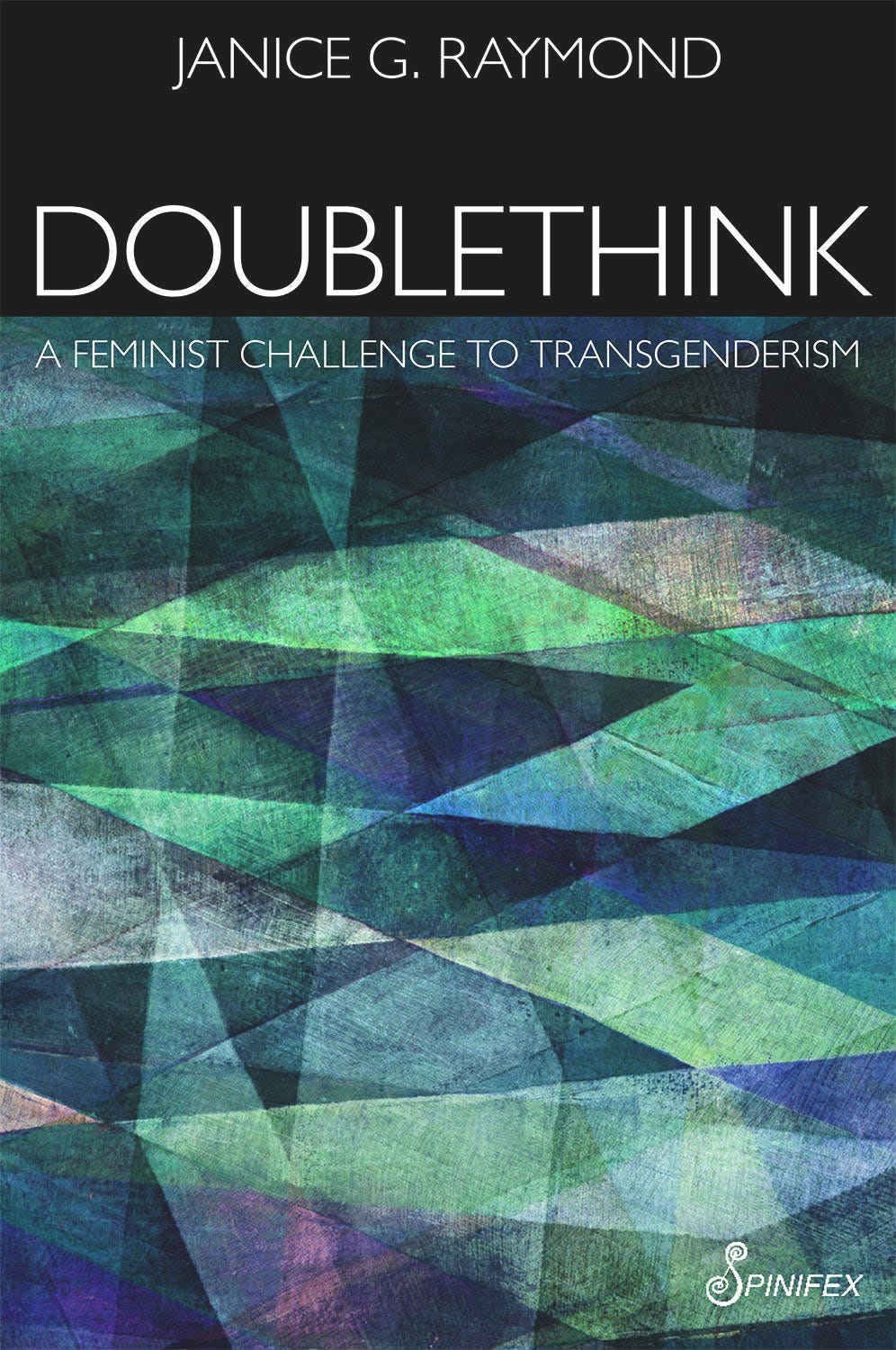
CLECKLEY (Voiceover): I chose chapter two of Doublethink, which is titled “The Rapid Rollout of Transgenderism: How Did It Happen?,” to pair with chapter one of The Transsexual Empire because of corresponding themes in content, particularly Raymond’s discussion of men fetishizing women. When I looked back at the transcript from the X space, I saw that the section for Doublethink could have been shortened to emphasize a few key ideas. I decided to do a separate recording here to reduce the length and focus on important concepts in that chapter.
CLECKLEY: Chapter two in Raymond’s Doublethink, titled “The Rapid Rollout of Transgenderism: How Did It Happen?,” begins with discussing the institutional capture and stifling of debate that have become common followed by the framing of “gender-affirming care” for children as “emergency health care.” This section covers issues like the “making” of “the transgender child,” the suicide threat, and pornography’s role in men’s fetishization of women. I will be highlighting work from Josephine Bartosch, Max Robinson, Genevieve Gluck, Alix Dobkin, and Germaine Greer as they appear in Raymond’s chapter.
On the “making” of “the transgender child,” Raymond cites Bartosch’s 2021 piece titled “America’s Creation of the Transgender Child,” that discusses how “the transgender child industry has outstripped policy.” Raymond references the piece to discuss the difference between the strikingly more profit-oriented approach in the U.S. versus the U.K. “The obvious difference is that in the United States,” Bartosch explains, “healthcare is dominated by the private sector who have an obvious motive to promote drugs and surgeries.” Bartosch’s piece also importantly notes the shift from “transsexual” to “transgender,” which “de-sexed what had previously been considered an adult psychosexual disorder” (emphasis added). Whereas talk of “transsexual” children would cause discomfort, “transgender” makes it suddenly palatable and, like in I Am Jazz, a mass consumable.
Bartosch has a recent book titled Pornocracy, co-authored with Robert Jessel, which I will be planning to review, perhaps as a break from discussing The Transsexual Empire.
See Josephine Bartosch, “America’s Creation of the Transgender Child,” The Post Millennial, April 3, 2021, https://thepostmillennial.com/americas-creation-of-the-transgender-child.
In the section discussing the suicide threat, Raymond cites Max Robinson’s 2021 book Detransition: Beyond Before and After to discuss the narrative of “transition or die miserable, sooner or later” (Robinson, qtd. in D, p. 59). Deriving power from the “born this way” narrative used for gay rights, the paradoxical “born in the wrong body” narrative deploys suicidal ideation to force compliance with individual demands. According to Robinson:
But it simply isn’t true . . . there is a very simplistic roadmap provided to patients diagnosed with gender dysphoria. The patient is in severe distress and the medical professional will alleviate that distress through prescribing hormones, performing surgery, or directing the patient to another medical professional who will facilitate these medical interventions. (Robinson, qtd. in D, pp. 59-60)
Raymond writes how “[t]he suicide threat is emotional blackmail that particularly exploits the guilt of parents” who feel skeptical about quick medicalization for their children. If parents even question puberty blockers or cross-sex hormones, then the prevailing narrative tells them they put their children at risk of suicide: “transition or die.” “The clinical message,” Raymond explains, “is that waiting or withholding treatment from youth transitioners may increase suicidal thoughts or actual suicides” (D, p. 60). Functioning as propaganda, suicide threat terrorizes parents and skeptical voices who otherwise would express criticism. Dressed in suicide, propaganda suppresses dissent.
See Max Robinson, Detransition: Beyond Before and After (Mission Beach, Australia: Spinifex Press, 2021).
Importantly, Raymond notes how the gender industry significantly intersects with the sex industry, an observation that connects to her earlier analysis in 1979. Here Raymond cites Genevieve Gluck’s work analyzing how pornography has influenced men’s desire to possess womanhood. Raymond quotes Gluck on the genre of pornography known as “sissy porn”:
The pornography typically involves men wearing lingerie and engaged in ‘forced feminization’—eroticizing the illusion of being made to ‘become women’ through dress, makeup, and sexual submissiveness, and the fetishizing of the humiliation this brings. (Gluck, qtd. in D, p. 75)
This analysis emphasizes the way in which pornography—in particular, “sissy porn”—socializes male sexuality toward a fantasy of being “female” built on dissociation from the self. With intoxicating effects, pornography facilitates escapes from selfhood. Gluck and I discussed transgenderism and objectification in a previous talk we did in 2022. Among her insights, she had said, “Pornography plays a big role in that it was women, first, whose bodies were being modified for sexual purposes, for the sexual pleasure of men.” Further research since 2021 has confirmed what Raymond and Gluck have known: Pornography has been an essential technology in transgenderism’s propagation.
Gluck is a co-founder of Reduxx, where more of her work can be seen there and via her Substack.
Genevieve Gluck, “Why Isn’t Anyone Talking About the Influence of Porn on the Trans Trend?” Feminist Current, November 29, 2020, https://www.feministcurrent.com/2020/11/29/why-isnt-anyone-talking-about-the-influence-of-porn-on-the-trans-trend.
Discussing men’s appropriation of lesbianism, Raymond cites lesbian feminist Alix Dobkin, who wrote pieces like “Love Women or Die: Are We an Endangered Species?” about how “diversity” extended from women “from a variety of racial, ethnic, and class backgrounds” to men. Here is a passage from Dobkin’s piece, part of which Raymond quotes:
In Lesbian community, ‘diversity’ used to be code for the coming together of Lesbians from a variety of racial, ethnic, and class backgrounds. But now those labels indicate the ‘inclusion’ of—you guessed it: ‘nice’ men, ‘supportive’ men, ‘curious’ men, ‘questioning’ men, ex-men, and anyone with a ‘sexual minority’ credential. In fact, it’s getting to the point where anyone who is oppressed for any reason can stake a claim to womanhood according to those who define ‘woman’ as ‘victim.’ (Dobkin, 2000, p. 9)
Raymond discusses an interesting possible analysis of cultural appropriation in regard to lesbians as a distinct group with a culture of their own. While many care about cultural appropriation in cases involving Native Americans, men can appropriate womanhood as if women have no identity. Raymond writes that “when men who identify as women claim they are women or lesbians, too many women disregard this appropriation of a female identity” (D, p. 86). An interesting part of Raymond’s analysis is that she acknowledges women’s collaboration in transgenderism and their complicity. She fairly acknowledges women’s role while neither scapegoating women and/or feminists nor erasing men’s responsibility.
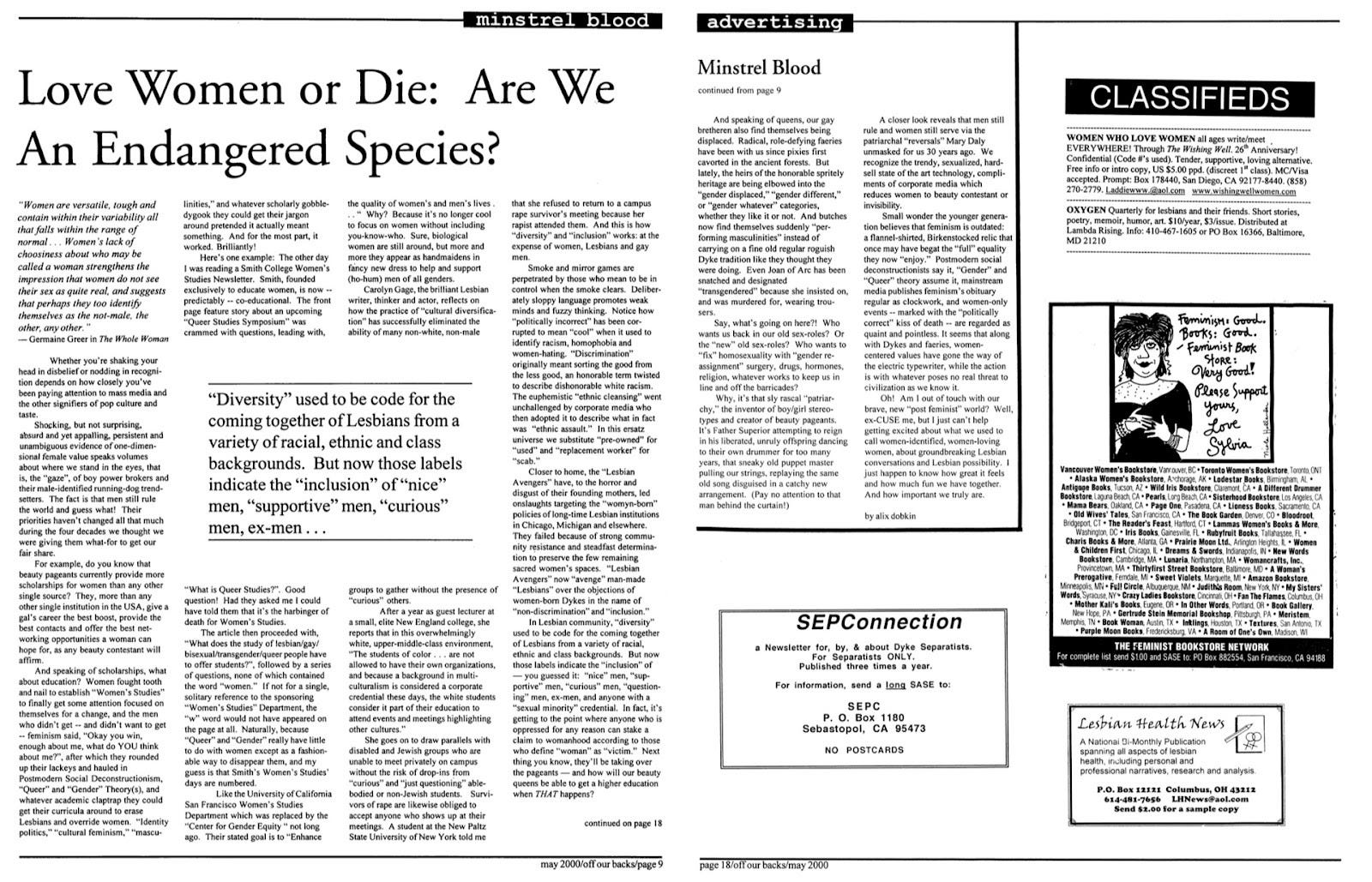
See Alix Dobkin, “Love Women or Die: Are We an Endangered Species?” off our backs, vol. 30, no. 5 (May 2000), 9, 18.
Closing the chapter, Raymond cites Germaine Greer’s 1999 book The Whole Woman, the sequel to her 1970 book The Female Eunuch. According to Greer: “Women’s lack of choosiness about who may be called a woman strengthens the impression that women do not see their sex as quite real, and suggests that perhaps they too identify themselves as the not-male, the other, any other” (Greer, qtd. in D, 86). Greer sharply questions women’s unfortunate and paradoxical identification with otherness in opposition to their own interests. There is this other line from Greer, where she writes: “Gender identification is never more than approximate” (p. 73). From transsexualism to transgenderism, many decades now tell us the approximation has been about sex-role stereotyping becoming sex itself. Pornography reiterates it. As Raymond has been right on this issue, so has Greer. Watching clips of Greer speaking, I think of how brilliant she has been for so many decades—not always agreeable, certainly, but always sharp. My hope is that more young women become as disagreeable and sharp in their own brilliance like Greer before them.
See Germaine Greer, The Whole Woman, 1999 (New York: Random House, 2000).
That was a discussion of chapter two of Doublethink titled “The Rapid Rollout of Transgenderism: How Did It Happen?,” which I shortened for the sake of this recording.
CLECKLEY (Voiceover): With his permission, like in Session I previously, I have included the commentary from Michael Costa, editor-in-chief with Gays Against Groomers. Costa asked some insightful questions, which I have included with my replies, as recorded during the space.
COSTA: Thanks so much for having me on, Don. I appreciate it. This is one of my favorite books, probably my favorite book—The Transsexual Empire. And it’s really nice being able to come to these sessions and hear your opinion on it, since you’re an expert on this stuff. I just want your opinion. When you examine the progression of the “trans agenda,” from back in the 1970s until current day, from back when Janice Raymond was researching and writing The Transsexual Empire, up until the current “kiddie cutter” cult that we’re trying to fight in the Supreme Court because they’re mutilating kids… When you look at the progression from when Jan Raymond wrote the first book, up until currently when she recently published Doublethink, given those two texts, do you think that Janice Raymond has been vindicated, or something else?
CLECKLEY: I would say that Raymond’s original analysis definitely has been vindicated. As we progress into The Transsexual Empire, we will be talking about the earlier theories around transsexualism and its development in children. They have been these dubious, really, social theories about child development that were given a kind of “scientific credibility.” Now, we look back on ideas from men like John Money and Robert Stoller, and we think they are quacks, and they were, clearly, abusive in their theories and practices regarding children and child development. So, I would say Raymond has been vindicated, but I think the problem is that so much of the public has been slow to recognize that, for one, what she wrote in The Transsexual Empire was not a “conspiracy theory.” She went out and interviewed and talked with the people at these clinics and the directors of the clinics—she actually talked with John Money and interviewed John Money.
The idea that she was just writing this “conspiracy theory” text, which trans activists want people to consider Raymond’s work a “conspiracy theory” text, is totally false. Raymond’s work was investigative journalism in the appropriate sense of the word, not in the sense of having a blog and lots of opinions, but in the sense of going out and really talking with people involved with these issues and seriously addressing the issues that they raise. My answer is “Yes.” She has been vindicated through the developments in the pushback against transgenderism and in the discoveries about how it has been abusive. But I think she has had the status of many women who have been Cassandras, which is to say they have warned us of the collapse or the destruction that would come, and they have found themselves disregarded by much of the society at large.
Had the majority of people even considered the ideas that she discussed, even without necessarily integrating the feminist understanding of patriarchy, even without that aspect of the analysis, they could have seen transsexualism as a farce early on. In the absence of the feminist aspects of the analysis, we can still see the problems with transsexualism in Raymond’s discussions of the sexologists and in her interviews with the men who were involved with it and the women like Zelda Suplee, who provided responses to Raymond’s interview questions.
COSTA: That was a really thorough and great answer. Fascinating. Thanks so much, Don.
CLECKLEY: Thank you so much, Michael! Thank you all for joining me again.
CLECKLEY (Voiceover): Thank you all so much for listening. There will be a text version of this talk available on my Substack, linked in the description below. Given that I have received some new archival texts, I would like to do shorter videos exploring them. Such talks will be structured differently from recording longer-form discussions. If you found value in this session about Janice G. Raymond’s work on transsexualism and transgenderism, then please like, subscribe, and share. For any followers who can do a paid subscription or a one-time donation, I appreciate it. It all helps. Again, thank you all so much.
If you are unable to become a paid subscriber through Substack, then please feel free to donate via PayPal, if able. I am grateful for reader support!