

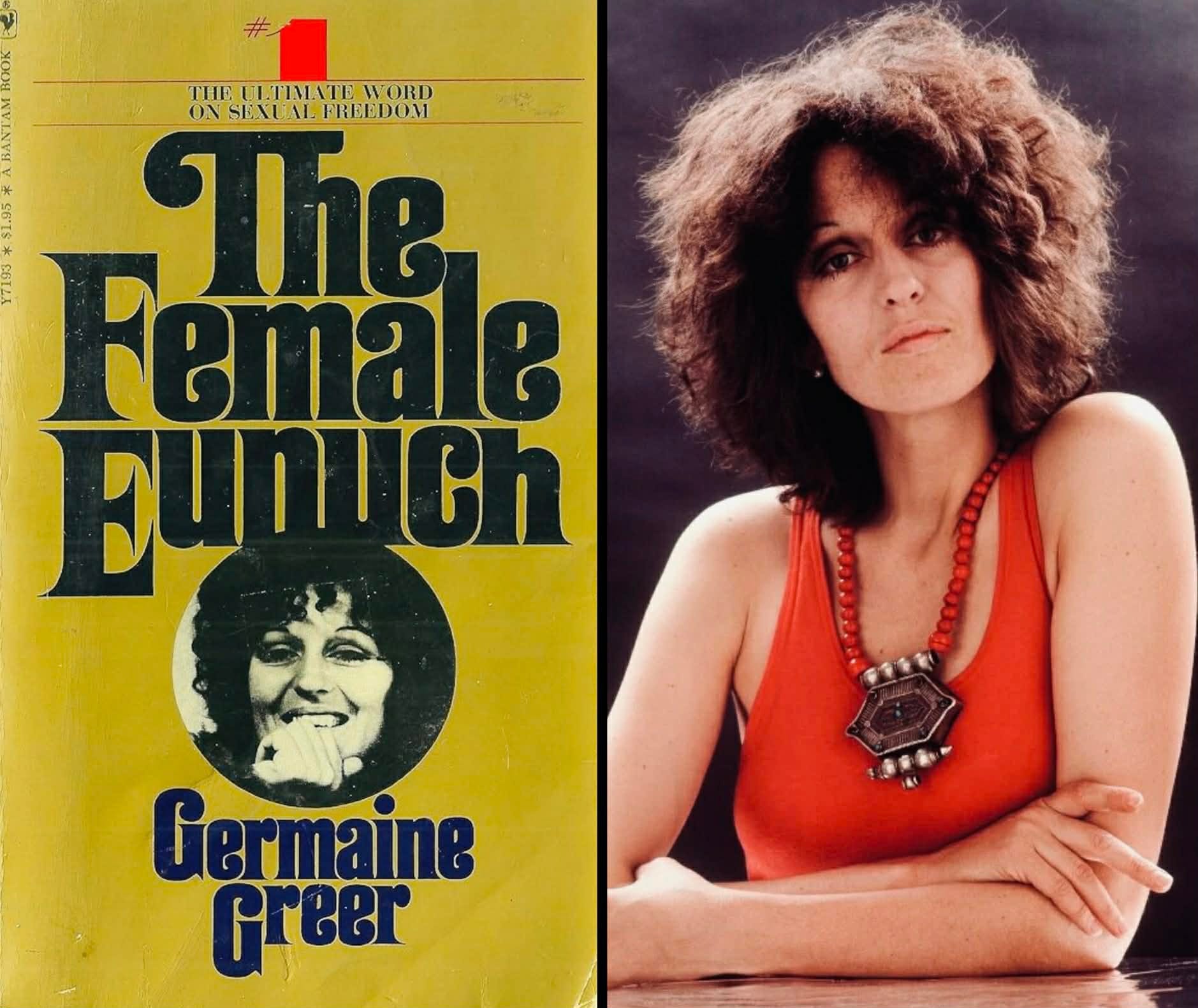
Here at the close of Women’s History Month, I want to recognize Germaine Greer for her brilliance in her 1970 book The Female Eunuch.
Excitingly, I have a few new recent additions to my archival collection, which I will be discussing in the coming days, including work from sexologists Magnus Hirschfeld and D.O. Cauldwell.
For now, this piece introduces readers to another figure who was a contemporary of both Havelock Ellis and Sigmund Freud: Otto Weininger.
Weininger thought the dimorphism of the sexes right through, and discovered that, given such a polarity, men could have no real communion with women, only a highly compromised shared hypocrisy. Valerie Solanas performed the same exercise for women, and found that men covet all that women are, seeking degradation and effeminization at their hands. She retaliated by shooting Andy Warhol in the chest. Weininger more honestly made his attempt upon himself and succeeded. Just as Solanas despises men as they present themselves to be and in their failure to live up to their own stereotype, Weininger despises women both because their image is passive and animalistic, and because they are not even genuinely so.
- Germaine Greer, The Female Eunuch
Otto Weininger (1880-1903) wrote Geschlecht und Charakter (Sex and Character), published in 1903, and died by suicide. Weininger’s Sex and Character argues that individuals possess both masculine and feminine, with masculine as positive and feminine as negative. He theorizes human beings as a mixture of male (“M”) and female (“W”) principles, somewhat like an early theorizing of “gender identity.” Women, Weininger argues, are entirely sexual and mindless, animalistic, lacking a continuous ego or transcendental subjective soul; in this view, women are simply vessels for male desire, matter for man to use at will. Despite being Jewish, Weininger was antisemitic and considered Jewishness a negative “psychic constitution,” similar to femaleness in negation.
Without going into great detail as to Weininger’s theories, here is a characteristic passage from his Sex and Character, all italics his:
The purpose of Woman, then, is to be non-purpose. She represents nothingness, the opposite pole to the divinity, the other possibility in humankind. That is why, quite rightly, nothing is regarded as more contemptible than a man who has become a woman, and why such a man is respected even less than the most dimwitted and coarsest criminal. And this also accounts for the deepest fear in Man: the fear of Woman, that is, the fear of meaninglessness, the fear of the tempting abyss of nothingness.
It is the old woman who wholly reveals what Woman is in reality. As experience also shows, the beauty of Woman is only created by Man’s love: a woman becomes more beautiful when a man loves her, because she passively complies with the will involved in his love. However mystical this may sound, it is a simple everyday observation. The old woman demonstrates that Woman never was beautiful: if Woman existed there would be no witches. But Woman is nothing, she is a hollow vessel covered for a while in makeup and whitewash.
All the qualities of Woman depend on her non-existence, her lack of essence: it is because she has no true, immutable life, but only an earthly one, that she assists procreation in this life by her matchmaking, and that she can not only be transformed by a man who has a sensual effect on her, but is receptive to all possible influences.
Otto Weininger, Geschlecht und Charakter (Sex and Character), 1903, trans. Ladislaus Löb, eds. Daniel Steuer with Laura Marcus (Bloomington: Indiana University Press, 2005), p. 268
Weininger reminds me of Andy Chu, known as “Andrea Long Chu,” a transgender writer who has written, quite infamously: “Sissy porn did make me trans” (p. 79). An intellectual son, Chu takes Weininger’s definition of femaleness in terms of negation and extends it to include himself sucked into “the tempting abyss of nothingness.” Less philosophically dressed, Chu puts his thesis more simply than Weininger: “The thesis of this little book is that femaleness is a universal sex defined by self-negation . . . Put more simply: Everyone is female, and everyone hates it” (p. 11) (emphasis added).
Wesley Yang wrote a 2008 piece in Tablet discussing Weininger that identifies his misogyny in a way eerily akin to Chu’s. “Weininger’s misogyny is eccentric,” Yang writes. “His extremism leads him, at times, to sound rather like a radical feminist” (emphasis added). “To be for women, imagined as full human beings, is always to be against females,” Chu writes. “In this sense, feminism opposes misogyny precisely inasmuch as it also expresses it” (p. 14) (emphasis added). (“Or maybe I’m just projecting,” so Chu says.). Weininger and Chu share a misogyny that exposes man’s deep grappling with his own identity and his faulty attempt to use woman as his spittoon.
Interestingly, Chu’s theory draws inspiration from Valerie Solanas, fetishizing the very concept of castration into “femaleness.” To quote Chu: “Gender is not just the misogynistic expectations a female internalizes but also the process of internalizing itself, the self’s gentle suicide in the name of someone else’s desires, someone else’s narcissism” (p. 35). “Sex change” provides a superficial “cure” for men who would be like Weininger and outright hate what they envy but cannot be: They can hate women as they claim womanhood itself. There is a connection here that I think Greer perfectly understands when she writes in her 1999 book The Whole Woman: “Whatever else it is gender reassignment is an exorcism of the mother.”
Here are some helpful resources discussing Weininger and Chu:
Wesley Yang, “Was This Man a Genius?” Tablet, August 13, 2008, https://www.tabletmag.com/sections/news/articles/was-this-man-a-genius.
Genevieve Gluck, “Why Isn’t Anyone Talking About the Influence of Porn on the Trans Trend?” Feminist Current, November 29, 2020, https://www.feministcurrent.com/2020/11/29/why-isnt-anyone-talking-about-the-influence-of-porn-on-the-trans-trend.
Blake Smith, “The Long Goodbye,” Tablet, April 13, 2023, https://www.tabletmag.com/sections/arts-letters/articles/the-long-goodbye-andrea-long-chu.
If you are unable to become a paid subscriber through Substack, then please feel free to donate via PayPal, if able. I am grateful for reader support!
The following is a selection from Greer’s Female Eunuch in which she writes perhaps the earliest feminist critique of Weininger, drawing the connection between his work and Freud’s sexual theories about women. I have left the block quotes Greer inserted throughout the section because I love how she composed The Female Eunuch. More nonfiction works should utilize this style, where there are “floating” block quotes accompanying the extended critique.
Germaine Greer, The Female Eunuch, 1970 (New York: Harper Perennial, 2008), 119-121, 129-131.
One of the fullest statements of the theory of the female soul was set out in Sex and Character, a remarkably rigorous and committed book by a mere boy, Otto Weininger, who committed suicide some years after its publication. His brilliant, neurotic life can be taken as an illustration of what dimorphism must eventually accomplish. By disintegrating human nature and building boundaries between warring halves, Weininger condemned himself to perversion, guilt, and early death. He began by identifying women with the body, with unconscious sexuality, and thereafter with passive animalism. As a rational male he condemned such a bestial element. “No men who think really deeply about women retain a high opinion of them; men either despise women or they have never thought seriously about them.”1
Like Freud, with whom he had much more in common, he thought of women as castrated by nature; because he thought so highly of the penis he thought women did too:
An absolute nude female figure in life leaves an impression of something wanting, an incompleteness which is incompatible with beauty . . .2
The qualities that appeal to a woman are the signs of a developed sexuality; those that repel her are the qualities of the higher mind. Woman is essentially a phallus worshipper . . .3
Weininger thought the dimorphism of the sexes right through, and discovered that, given such a polarity, men could have no real communion with women, only a highly compromised shared hypocrisy. Valerie Solanas performed the same exercise for women, and found that men covet all that women are, seeking degradation and effeminization at their hands.4 She retaliated by shooting Andy Warhol in the chest. Weininger more honestly made his attempt upon himself and succeeded. Just as Solanas despises men as they present themselves to be and in their failure to live up to their own stereotype, Weininger despises women both because their image is passive and animalistic, and because they are not even genuinely so. Their pretence is brought about by the exigency of the sexual situation which they exploit, hence the duplicity and mendacity which characterize all their actions. Because woman lives vicariously she need take no moral responsibility for her behaviour: because she has no responsibility she has no morality and no ego. Because of the lack of ego and the variety of roles that women manipulate, they have no identity, as one may guess from their willingness to give up their names. Woman is never genuine at any period of her life.5
The most chastening reflection is that Weininger was simply describing what he saw in female behaviour around him. He could not see that these deformities were what women would one day clamour to be freed from. As far as he could see, women were like that and he did not know what came first, their condition or their character. He assumed that it must have been the latter, because he could not explain their condition any other way.
Political and civic equality of the sexes implies moral equality. It implies the perfectly appalling logical consequence that the morals of women shall in future be the same as those of respectable Christian Victorian man—at best. That, of course, means the total collapse of Christian morality.
Robert Briffault, Sin and Sex, 1931, p. 132
All the moral deficiences Weininger detected masqueraded in Victorian society as virtues. Weininger is to be credited with describing them properly. Nevertheless his concepts of ego, identity, logic and morality were formed from observation of this same undesirable status quo, and women today might well find that what Weininger describes as defects might be in fact freedoms which they might do well to promote. For example:
With women thinking and feeling are identical, for man they are in opposition. The woman has many of her mental experiences as henids (undifferentiated perceptions) whilst in man these have passed through a process of clarification.6
‘Definitio est negatio.’ We might argue that clarification is tantamount to falsification: if you want to know what happened in a particular situation you would be better off asking someone who had perceived the whole and remembered all of it, not just some extrapolated clarification. How sad it is for men to have feeling and thought in opposition!
[119-121]
Nowadays education itself is changing so that creative thought does not decline with the inculcation of mental disciplines, which are now not taught as ends but simply as means to other ends. Unfortunately, the chief result of the change so far seems to be the reluctance of children to study science, but eventually science itself will become a complete study.
Weininger has more serious charges though:
A woman cannot grasp that one must act from principle; as she has no continuity she does not experience the necessity for logical support of her mental processes…she may be regarded as ‘logically insane’.7
It is true that women often refuse to argue logically. In many cases they simply do not know how to, and men may dazzle them with a little pompous sophistry. In some cases they are intimidated and upset before rationalization begins. But it is also true that in most situations logic is simply rationalization of an infra-logical aim. Women know this; even the best educated of them know that arguments with their menfolk are disguised real-politik. It is not a contest of mental agility with the right as the victor’s spoils, but a contest of wills. The rules of logical discourse are no more relevant than the Marquess of Queensberry’s are to a pub brawl. Female hardheadedness rejects the misguided masculine notion that men are rational animals. Male logic can only deal with simple issues: women, because they are passive and condemned to observe and react rather than initiate, are more aware of complexity. Men have been forced to suppress their receptivity, in the interests of domination. One of the possible advantages of the infantilization of women is that they might after all become, in the words of Lao-Tse, “a channel drawing all the world towards it” so that they “will not be severed from the eternal virtue” and “can return again to the state of infancy.”8 If only the state of women were infancy, and not what we have reduced infancy itself to, new possibilities might be closer to realization than they seem. When Schopenhauer described the state of women as moral infancy, he was reflecting not only his prejudice against women, but also against babies. The failure of women to take logic seriously has serious consequences for their morality. Freud adds the gloss to Weininger’s text:
I cannot evade the notion (though I hesitate to give it expression) that for women the level of what is ethically normal is different from what it is in men. Their superego is never so inexorable, so impersonal, so independent of its emotional origins as we require it to be in men. Character-traits which critics of every epoch have brought up against women—that they show less sense of justice than men, that they are less ready to submit to the great exigencies of life, that they are more often influenced in their judgements by their feelings of affection or hostility—all these would be amply accounted for in the modification of the formation of their superego . . . We must not allow ourselves to be deflected from such conclusions by the denial of the feminists, who are anxious to force us to regard the two sexes as completely equal in position and worth.9
The circularity of this utterance is quite scary. After all, are the sexes equal in position and worth or not? What is position? What is worth? He promises to explain unsubstantiated deficiencies in the female character by an unsubstantiated modification in an unsubstantiated entity, the superego: if physiology is destiny Freud is anxious to invent a physiology of the mind. If judgement had not been separated from feeling so unnaturally in the Nazi officers presumably they would not have carried out orders so crisply. What kind of a criticism is it to say that women are less stoical than men? After two world wars stoicism seems to have outlived its value. If women have been denied moral responsibility by male ‘justice’ and dubbed angels while they were treated with contempt, it is likely that they will have formed their own conclusions about the monstrous superego and illusory morality of men. Protestant Europe has set for itself an unattainable morality of integrity in defiance of heavenly mercy, the unaided conscience bowed by full and unending responsibility for all actions, despite the partiality of knowledge and infirmity of will which characterize human action. Freud saw the results in his own community but he could not postulate an alternative to guilt and neurosis. The chief mainstay of such religion is the capacity of the ego to continue repression. Women may be bad at keeping up the cycle of the organism punishing itself, but that too may be an advantage which involves less delusion than its opposite.
The feeling of identity in all circumstances is quite wanting in the true woman, because her memory, even if exceptionally good, is devoid of continuity . . . women if they look back on their earlier lives, never understand themselves.10
My colleague Nathan Leites, Ph.D., has concluded after a review of the literature that the term ‘identity’ has little use other than as a fancy dress in which to disguise vagueness, ambiguity, tautologies, lack of clinical data, and poverty of explanation.
Robert Stoller, Sex and Gender, 1968, p. x
On Weininger’s evidence the ego is ersatz, consisting of the memory of the self which exists at any particular time. He remarks with horror that if you ask a woman about herself, she understands it to be her body. She does not seek to define herself by asserting her image of her merit, her behaviour. Man has a temporal notion of identity, which is falsifiable, woman a simple spatial one. “Here you are” said the white buttons Yoko Ono gave away at her exhibition. It seems important after all. Perhaps woman, like the child, retains some power of connecting freely with external reality. Weininger seemed to think so. “The absolute female has no ego.”11
The primal act of the human ego is a negative one—not to accept reality, specifically the separation of the child’s body from the mother’s body…this negative posture blossoms into negation of self (repression) and negation of the environment (aggression).12
What a blossoming! If women had no ego, if they had no sense of separation from the rest of the world, no repression and no regression, how nice that would be! What need would there be of justice if everyone felt no aggression but infinite compassion! Of course I am taking advantage of the masters of psychology, bending and selecting their words like this, but what else can they be for? We cannot allow them to define what must be or change would be impossible. Whitehead and Needham looked forward to a new kind of knowledge which would correct the insanity of pure intelligence, “a science based on an erotic sense of reality, rather than an aggressive dominating attitude to reality.”13 If wisdom might not be incompatible with a low sense of ego, then charity seems in the mystical definitions of it to be dependent upon such a corrosion of separateness: the greatest myth of Christianity is that of the mystical body.
To heal is to make whole, as in wholesome; to make one again; to unify or reunify; this is Eros in action. Eros is the instinct that makes for union, or unification, and Thanatos, the death instinct, is the instinct that makes for separation or division.14
Weininger’s disgust for Eros and his devotion to Thanatos drive him to state women’s comprehensiveness more fully. Believing him we might think we had been saved already:
This sense of continuity with the rest of mankind is a sexual character of the female, and displays itself in the desire to touch, to be in contact with the object of her pity; the mode in which her tenderness expresses itself is a kind of animal sense of contact. It shows an absence of that sharp line that separates one real personality from another.15
Poor Weininger finally cut himself off altogether in a last act of fealty to death. The immorality of individualism is obvious in an age when loneliness is the most pernicious disease of our overcrowded metropolises. The results of parcelling families in tiny slivers living in self-contained dwellings has defaced our cities and created innumerable problems of circulation and cohabitation. The sense of separateness is vainly counteracted by the pressure for conformity without community. In most of the big cities of the world the streets are dangerous to walk upon. Woman’s oceanic feeling for the race has little opportunity for expression; it is grotesquely transmogrified in organized works of charity, where her genius for touching and soothing has dwindled into symbolic attitudinizing. Weininger’s repugnance for animal contact is still universal among the northern races. Even crushed against his brother in the Tube the average Englishman pretends desperately that he is alone. Psychoanalysis, the most obscenely intimate contact of all, is not hallowed by any physical contact. Latterly, special classes form in church halls in arty suburbs, so that men and women can recover their sense of reassurance by touch. Too late for Weininger.
Might the cleavage between the subjective and objective have been badly made; might the opposition between a universe of science—entirely outside of self—and a universe of consciousness—defined by the total presence of self to self—be untenable? And if realistic analysis fails will biology find its method in an ideal analysis of the psychomathematical type, in Spinozistic intellection? Or might not value and signification be intrinsic determinations of the organism which could only be accessible to a new mode of ‘comprehension’?
Maurice Merleau-Ponty, The Structure of Behaviour, p. 10
[123-128]
The prevailing criticism of the female soul can best be explained by the male battle to repress certain faculties in their own mental functioning. Women possessed in abundance those qualities which civilized men strove to repress in themselves, just as children and savages did. The value of such criticism is in the degree to which it reveals the severity of the contouring of the ideal personality, that is to say, male criticism of the female mind is revealing only of the male himself. Men in our culture crippled themselves by setting up an impossible standard of integrity: women were not given the chance to fool themselves in this way. Women have been charged with deviousness and duplicity since the dawn of civilization so they have never been able to pretend that their masks were anything but masks. It is a slender case but perhaps it does mean that women have always been in closer contact with reality than men: it would seem to be the just recompense for being deprived of idealism.
For a Tear is an Intellectual thing,
And a Sigh is the Sword of an Angel King,
And the bitter groan of a Martyr’s woe
Is an Arrow from the Almightie’s Bow.
Blake, Jerusalem, p. 52
If women understand by emancipation the adoption of the masculine role then we are lost indeed. If women can supply no counterbalance to the blindness of male drive the aggressive society will run to its lunatic extremes at ever-escalating speed. Who will safeguard the despised animal faculties of compassion, empathy, innocence, and sensuality? What will hold us back from Weininger’s fate? Most women who have arrived at positions of power in a man’s world have done so by adopting masculine methods which are not incompatible with the masquerade of femininity. They still exploit the sadomasochistic hook-up of the sexes, in which “we have only the choice of being hammer or anvil.”16 Wanda wore feminine clothes to add poignancy to her torture of Gregor, just as Mrs. Castle made sure that she looked attractive when she went to berate the workers as a criminal and irresponsible element in society. It is up to women to develop a form of genuine womanpower against which the Omnipotent Administrator in frilly knickers cannot prevail.
There is much to suggest that when human beings acquired the powers of conscious attention and rational thought they became so fascinated with these new tools that they forgot all else, like chickens hypnotized with their beaks to a chalk line. Our total sensitivity became identified with these partial functions so that we lost the ability to feel nature from the inside, and more, to feel the seamless unity of ourselves and the world. Our philosophy of action falls into the alternatives of voluntarism and determinism, because we have no sense of the wholeness of the endless knot and of the identity of its actions and ours.
A.E. Watts, Nature, Man, and Woman, 1958, p. 12
Womanpower means the self-determination of women, and that means that all the baggage of paternalist society will have to be thrown overboard. Woman must have room and scope to devise a morality which does not disqualify her from excellence, and a psychology which does not condemn her to the status of a spiritual cripple. The penalties for such delinquency may be terrible for she must explore the dark without any guide. It may seem at first that she merely exchanges one mode of suffering for another, one neurosis for another. But she may at last claim to have made a definite choice which is the first prerequisite of moral action. She may never herself see the ultimate goal, for the fabric of society is not unravelled in a single lifetime, but she may state it as her belief and find hope in it.
The great renewal of the world will perhaps consist of this, that man and maid, freed from all false feeling and aversion, will seek each other not as opposites, but as brother and sister, as neighbours, and will come together as human beings.17
[129-131]


Otto Weininger, Sex and Character (London, 1906), p. 236.
Ibid., p. 241.
Ibid., p. 250.
Valerie Solanas, S.C.U.M. Manifesto (New York, 1968), p. 73.
Weininger (op. cit.), p. 274. The claim that deceitfulness is a secondary sexual characteristic of the female mind has been made by many observers, including feminists like Mary Wollstonecraft who saw it as an essential consequence of female degradation and B.L. Hutchins, Conflicting Ideals: Two Sides of the Woman Question (London, 1913), “Girls have been brought up on intensely insincere ideals” (p. 30).
Weininger (op. cit.), p. 100. The assumption that women perceive differently than men and so on, despite the failure of testing to indicate any justification for them, are taken on trust by psychologists who deal with femininity. Deutsch luxuriates in extolling the value of women’s subjective, intuitive perception as the desirable complement to male objectivity and mental aggression.
Weininger (op. cit.), p. 149.
J. Needham, Science and Civilization in China (Cambridge, 1954), Vol. II, p. 58.
S. Freud, Some Psychic Consequences of the Anatomical Distinction Between the Sexes, Complete Works, Vol. xix, pp. 257-8.
Weininger (op. cit.), p. 146.
Ibid., p. 186.
Norman O. Brown, Life Against Death (London, 1968), p. 145.
Ibid., p. 276.
Norman O. Brown, Love’s Body (New York, 1966), p. 80.
Weininger (op. cit.), p. 198.
Leopold Von Sacher-Masoch, Venus in Furs (London, 1969), p. 160.
Rainer Maria Rilke, Letters to a Young Poet (Edinburgh, 1945), p. 23.